

The Radio Group
The Most Speculative Theme of the Roaring Twenties

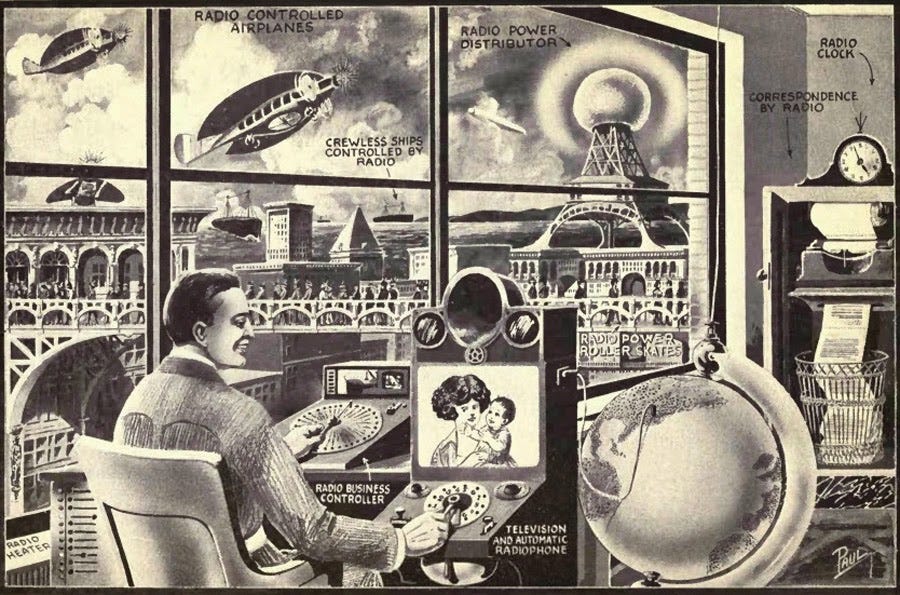
In the pantheon of the market’s greatest speculative themes, nearly all of them were hailed in their time as man’s greatest achievement. They emanated from a technology with the power to transform the human world and to divide history into the primitive past and a newly imagined modern age. In the 1920s, no technology was viewed as more revolutionary than the radio, or ‘‘wireless” as it was commonly referred to. Not only was it a source of “free” music and entertainment, but the technology allowed for long-distance, near-instant communication similar to a telephone. That may have been some of the more popular ways radio was used, but it was also a critical piece of infrastructure for the Navy and shipping industry and the very nascent aviation industry. Radio technology was even used for navigation via the radio compass. But like most of these revolutionary technologies, human imagination began crafting an ever-expanding list of future uses, each seeming more incredible than the last.
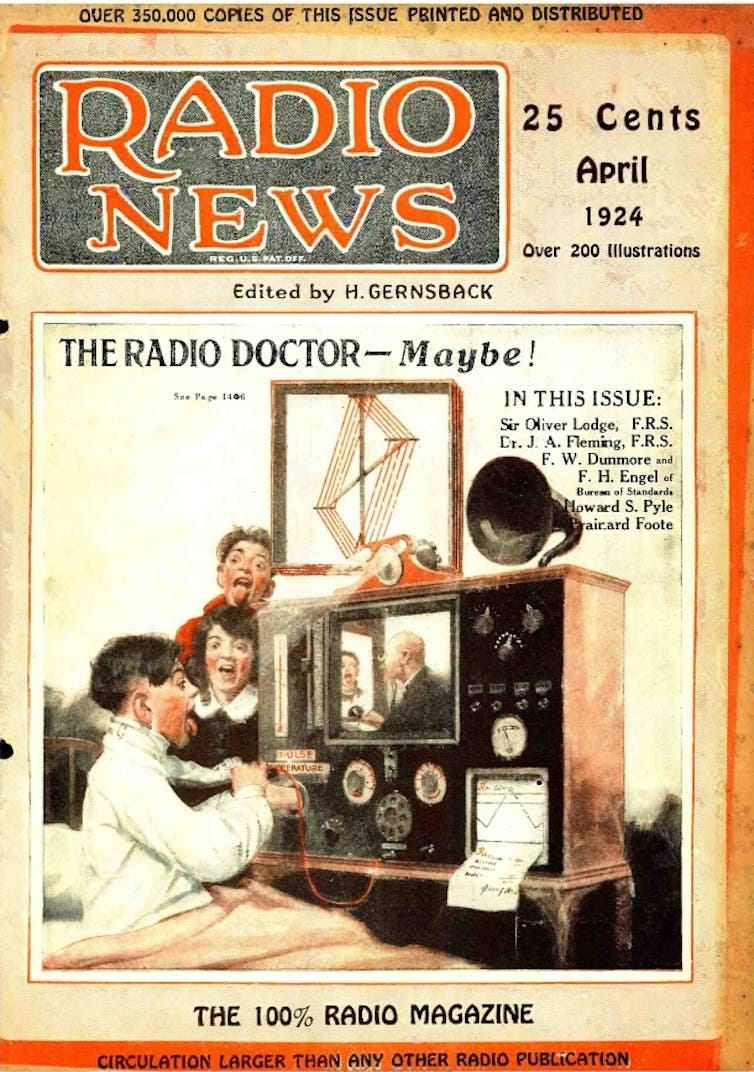
There was the radio clock, radio-controlled vehicles (drones), radio pictures (which became television), radio phones, radio doctors that could diagnose a patient through television just like telemedicine today, radio education or schooling (remote learning), radio-controlled appliances (IoT), and some even believed it would be possible to use the radio to communicate with the dead or with Martians. The father of radio, Guglielmo Marconi, in 1919 claimed that he may have been receiving Morse code messages from outer space.
There was even the emergence of radio prospecting—the use of radio equipment to find gold buried in the ground. The idea was that different substances have different electrical properties. By using electromagnetic equipment, they could determine the composition of certain elements or objects underground. And this crazy idea…actually worked. It was mostly used to identify promising mining locations and oil wells, but couldn’t point directly to a confirmed large deposit of gold or oil.
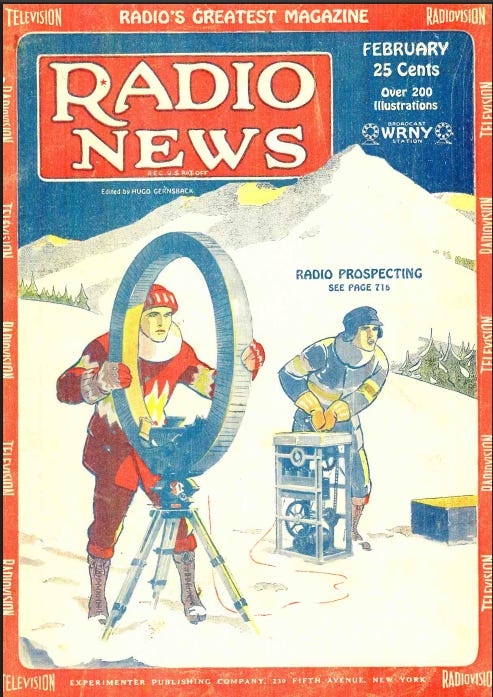
All of these ideas about the future of what radio could be only fanned the flames of speculation in radio stocks during the 1920s. Radio stocks are still thought of today as the most speculative of the stocks traded in the Roaring Twenties, and it’s true. Radio stocks were the most speculative of the speculative stocks of the decade, like the meme stocks of their day. Radio companies were seen as the natural inheritor of the future technology that would dominate everyday life from entertainment to health to transportation. In some respects they were right, albeit very early, and in others they were completely off base.
The revolutionary and transformative power of radio technology was one of the first to truly capture the imagination of the wider public in its time. So it’s a reasonable outcome that such a technology would become the center of wild speculation not only in the minds of consumers, but in the heart of the financial districts as well. But before we get into the actual companies and stocks that composed the symphony of speculation in Wall Street later in the decade, it’s important to go back to the start of the commercial radio industry and see how the medium developed. Only then will we be able to get a real sense of what it may have been like to be a wide-eyed trader at the height of the radio boom in the market.
Early Radio
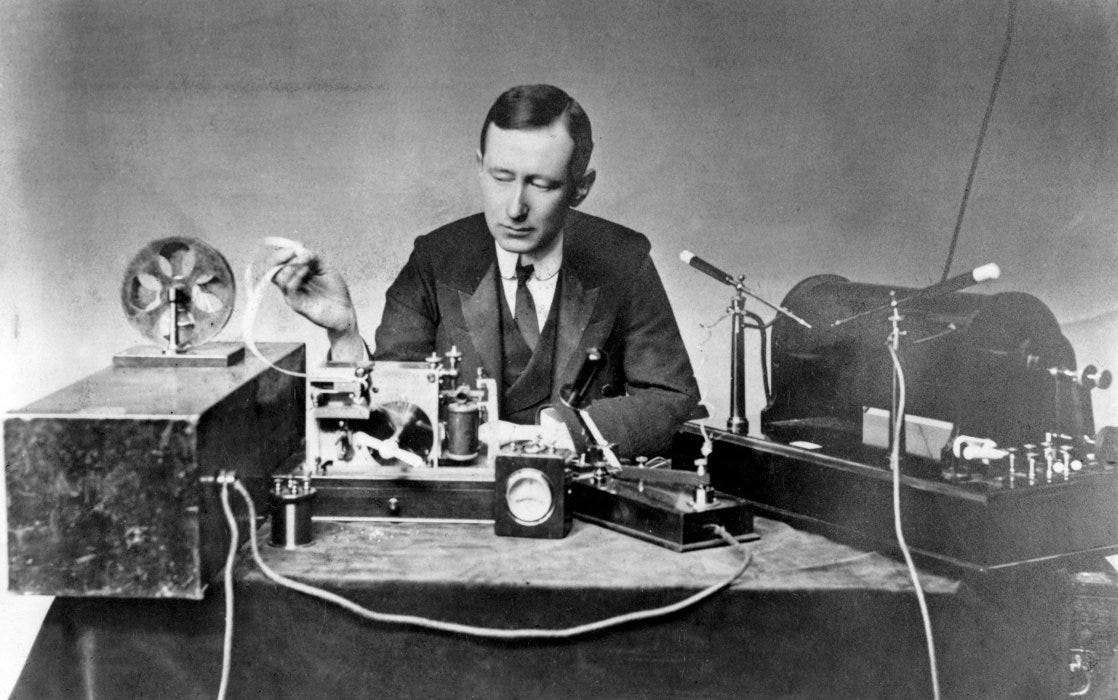
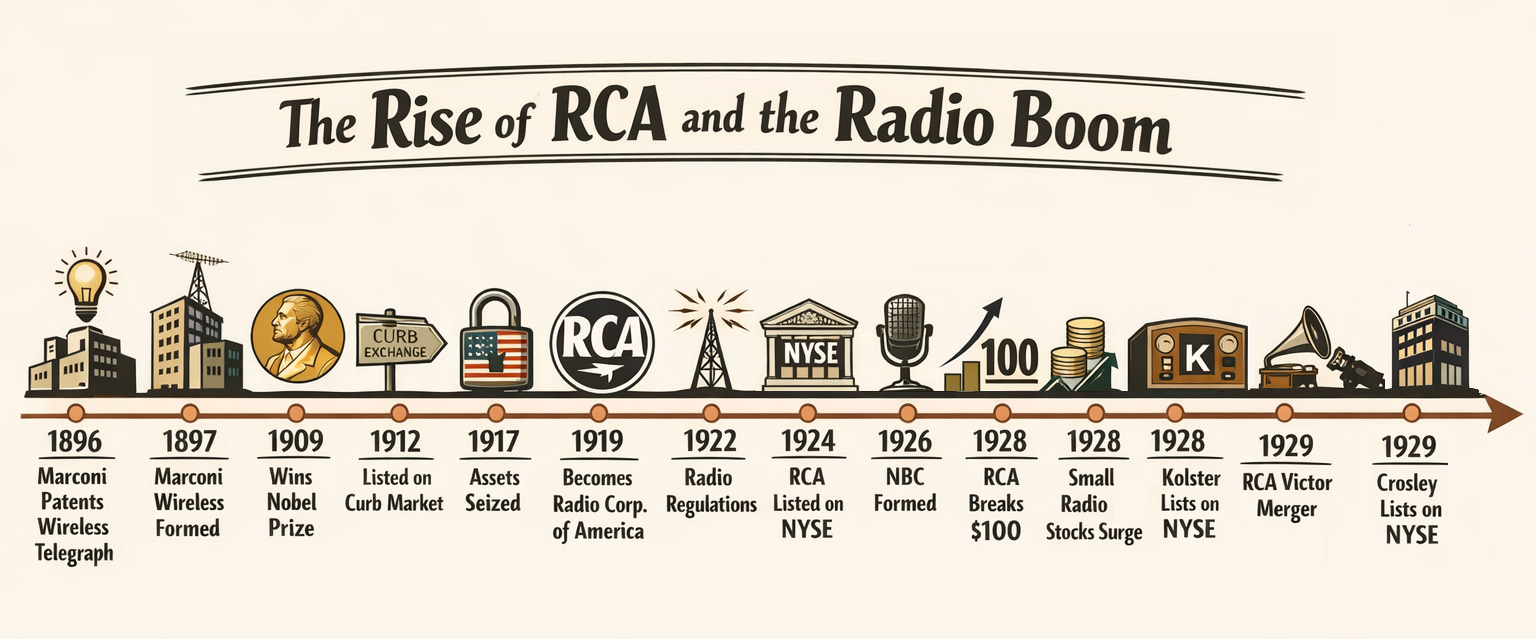
Guglielmo Marconi is widely considered to be the father of the radio industry, having patented his invention of the wireless telegraph in 1896. In 1899 he sent longwave radio signals across the English Channel and demonstrated the long-range communication potential of this technology. Using this wireless transmission, he was able to send updates on the America’s Cup race in New York back to shore to be written up in newspapers before the ships had returned to the coast, demonstrating the usefulness of this new technology. Almost immediately, navies began to take a keen interest in this wireless technology and they soon employed its use as critical communications infrastructure.
Radio was instrumental in helping ships send and receive information while at sea. It saved lives through distress signals if they were stranded or in danger of sinking. In 1912, the sinking of the RMS Titanic cemented wireless as a crucial piece of infrastructure and soon standardization and regulation followed. Coastal radio stations and ships became linked in a continuous wireless information system. Whereas before radio had been an intermittent emergency device and curiosity, it was now established infrastructure with a persistent flow of information, manned 24 hours a day.
With the outbreak of war in Europe and America entering the fray in 1917, radio was incredibly important for communication and intelligence. That year the Navy took control of the American radio infrastructure, the government ceased all work in wireless patent disputes, and pooled all related patents together so they would be available to all wireless technology companies to create standardized products for the war effort.
As the war came to an end in late 1918, the government put control of radio back in private hands, with one important exception. The US government recognized the immense importance of radio communication during the war and how foreign interference with American infrastructure could be a serious threat. They decided that any foreign-owned wireless infrastructure in the nation would henceforth be property of the United States. The most consequential of these seized assets was that of the Marconi Wireless Telegraph Company of America, or simply American Marconi, the American subsidiary of Marconi’s main British company. This act would directly lead to the formation of the largest and most recognizable name in the entire radio industry in the following decade and beyond.
The Birth of Commercial Radio
As far back as 1916, American Marconi executive, and future leader of RCA, David Sarnoff foresaw a bright and diversified future for the use of radio in a commercial capacity. In a memo he wrote to his superiors at Marconi in 1916, and later again in 1920, he outlined his vision for what would essentially become the radio industry that we have come to know:
"I have in mind a plan of development which would make radio a `household utility' in the same sense as the piano or phonograph. The idea is to bring music into the house by wireless. The receiver can be designed in the form of a simple radio music box and arranged for several different wavelengths, which should be changeable with the throwing of a single switch or pressing of a single button. The radio music box can be supplied with amplifying tubes and a loudspeaker telephone, all of which can be neatly mounted in one box. The box can be placed on a table in the parlor or living room, the switch set accordingly and the transmitted music received."
His Marconi superiors would pass on his idea as being too fanciful. But his employer several years later would give him the backing he needed.
In 1919, out of the seized assets of American Marconi and through agreements between General Electric, Westinghouse, and United Fruit, the Radio Corporation of America (RCA) was born. GE and Westinghouse pooled radio patents together and brought different wireless technology experience while United Fruit operated an international radio network for its massive shipping fleet. RCA, as a patent pool, was viewed as effectively a government sanctioned monopoly on the radio industry.
At this time radio was still mostly government infrastructure, used for naval and shipping, and was a curiosity for individual radio enthusiasts. But executives at RCA gave Sarnoff $2,000 to develop a commercially viable home radio receiver. He estimated they would need to build 1M sets over the next three-year period, and if sold at $75 each, could generate $75M in sales. The company ended up selling $83M worth over that period. Sarnoff quickly rose through the ranks in RCA to become the Vice-President and General Manager, effectively gaining operational control of the company.
Although Sarnoff helped develop early commercial radio sets for home consumers, Westinghouse is considered to be the first to sell these types of radios. They launched their broadcast station, KDKA, in late 1920. They soon realized that continuous broadcasting of entertainment would help sell more radio sets.
A number of early radio broadcasts were crucial in spurring leaders like GE, Westinghouse, and RCA into building out the commercial radio industry. The inauguration of president Harding in 1921, and Jack Dempsey’s boxing matches were figurative lightning rods for the industry. They were broadcast more or less at the same time to millions across the nation and gave them all something to collectively experience simultaneously regardless of where they were. In the following days everyone would be talking about those same events. It was the perfect mass medium for the spread of art and culture, and of course commercials.
By this time radio was growing rapidly in popularity, but the government hadn’t foreseen the rise of the commercial broadcasting industry. The airwaves were a wild west, cluttered with random broadcasters and home radio tinkerers sending out broadcasts on overlapping frequencies. The chaos was getting out of hand and something needed to be done about it.
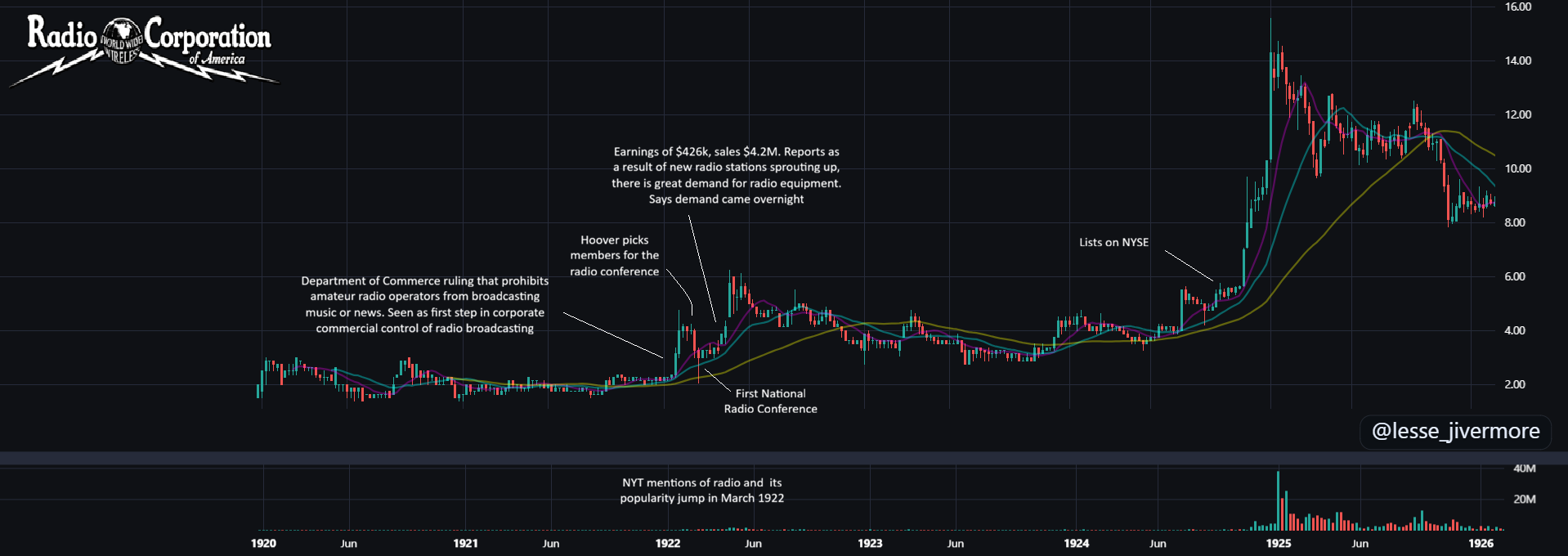
In 1922, under Commerce Secretary, Herbert Hoover, the government created a new distinct license for radio broadcasting, cementing legitimacy and legal certainty around how the industry could begin to operate commercially. The floodgates had opened. In March of that year there were 27 licensed broadcast stations. By the next month there were 88. By the following month there were 99. And by the end of the year there were over 550 licensed stations in the US. The industry was experiencing a parabolic ascent.
Before March 1922, there was no section in the NYT showcasing the day’s or week’s radio programs. But after March 1922 it became ubiquitous in the paper. In fact, searching for the term “radio” in the NYT between March 1, 1921 to March 1, 1922 gives a total of 565 results. That same search between March 1, 1922 to March 1, 1923 gives 1,821 results, an increase of over 220%. In that same period, 1928—1929, the results total over 7,000. This period of rapid change in the industry would set up the tremendous growth that would occur later in the decade.
It was only at this inflection point that radio became a factor in the stock market.
Radio In The Stock Market
As far as I can tell, the first wireless radio stock listed on the major New York stock exchanges was the Marconi Wireless Telegraph Company of America which listed on the New York Curb Exchange in 1912. For most of its existence it was a thinly traded, unimportant penny stock that was rarely worth mentioning. Although its assets had been seized by the US government in 1917, it continued to trade throughout the war period. Once the US declared it would not relinquish control of Marconi back to foreign owners, and oversaw the creation of RCA, the old Marconi company turned into RCA on the exchange.
RCA, like the Marconi company before it, was an uninspiring penny stock that was hardly noteworthy. Although it ran from $2-$6, it languished between $2-$5 for the first ten years (1912-1922) on the Curb without gaining much attention from traders. 1922 also marked the year when other small radio companies like Dubilier Condenser & Radio, a manufacturer of capacitors for radios, listed shares on the Curb Exchange in the wake of the new regulatory framework for the commercial radio industry. As we will see, both of these stocks would experience a change in fortune in 1924.
By mid 1924 there were several more listed companies involved in the radio industry on the exchanges. Apart from the small players on the Curb Exchange, RCA’s parent companies, GE and Westinghouse, were big players in the manufacturing of radios, radio equipment, and broadcasting, among other industries. There was also AT&T, which owned and operated broadcast stations. AT&T was a strategic member of the group that controlled RCA for a short time after its inception. They also controlled telephone lines which would carry long-distance radio broadcasts to local stations. For the most part, this was the extent of the radio industry’s presence in the market at the time.
Several months later in October of 1924, the great bull market was already well underway and the exchanges had welcomed some new radio stocks to their listings. All of them were small and thinly traded penny stocks. Among them were the Hazeltine Corp. (a radio engineering and patent licensing company), Ware Radio (manufacturer of small radio kits), Tower Manufacturing (radio component manufacturer), Inter-Ocean Radio, Jones Radio, Thompson Radio, and Rova Radio— all small manufacturers of radios or radio parts. Into early 1925, the curb exchange saw a handful more of small radio stocks pop up. These stocks enjoyed a brief moment in the sun shortly after listing in late 1924 and into the first part of 1925 before liquidity evaporated and their prices tanked. Many of them were never seen on the stock list again after early 1925, gone as fast as they came. These were the most speculative of speculative issues in the market at the time.
-(It is important to keep in mind the fact that at this time in the 1920s, it was extremely common to buy stocks on heavy margin. It would have been typical to buy stocks on margin of 5-to-1 or even 10-to-1. So for every dollar a given stock moved, it felt like $5-$10 for many of the investors and traders in these stocks.)
One major change for the group at this time is that on October 1, 1924, RCA became the first and only pure play radio stock to be listed on the NYSE. Where the Curb Exchange was typically for more speculative, lower capitalized issues, the NYSE was the prestigious big leagues where only the best quality stocks were listed (supposedly). RCA would remain the only pure play radio stock on the NYSE until 1928.
Also in early October, the Third National Radio Conference was held. At the conference, it was determined that regulations of the radio industry would change in January. Among other changes, it was noted that radio spectrum would be formalized and managed to avoid broadcasts over the same frequency. And, more importantly for RCA, radio stations would be classified by transmitter power, favoring larger high-power stations.
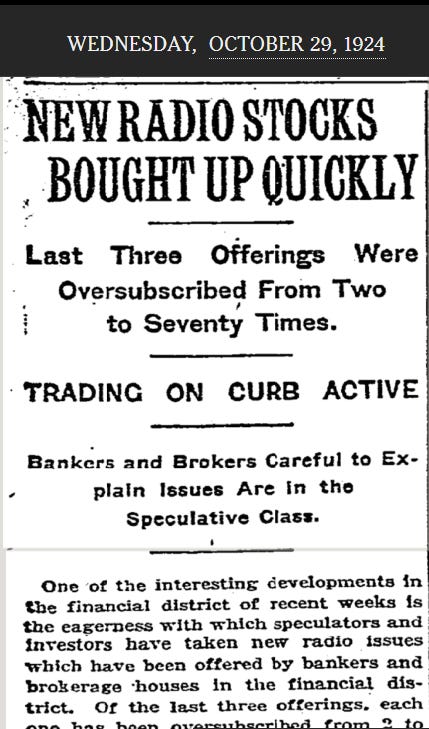
In November of 1924, Calvin Coolidge won the presidential election, sparking the real beginning of the more speculative side of the bull market. Specifically relevant to the radio group was a huge radio show held in NYC around the time of the election where radio-phonograph combination sets were shown. One large manufacturer of radio products mentioned the huge increase in demand and production they were experiencing. Within days, RCA, the stock traders knew simply as “Radio,” woke from its seemingly eternal slumber, shooting up from around a pre-split $25 in early November to just under $78 two months later on exceptional volume.
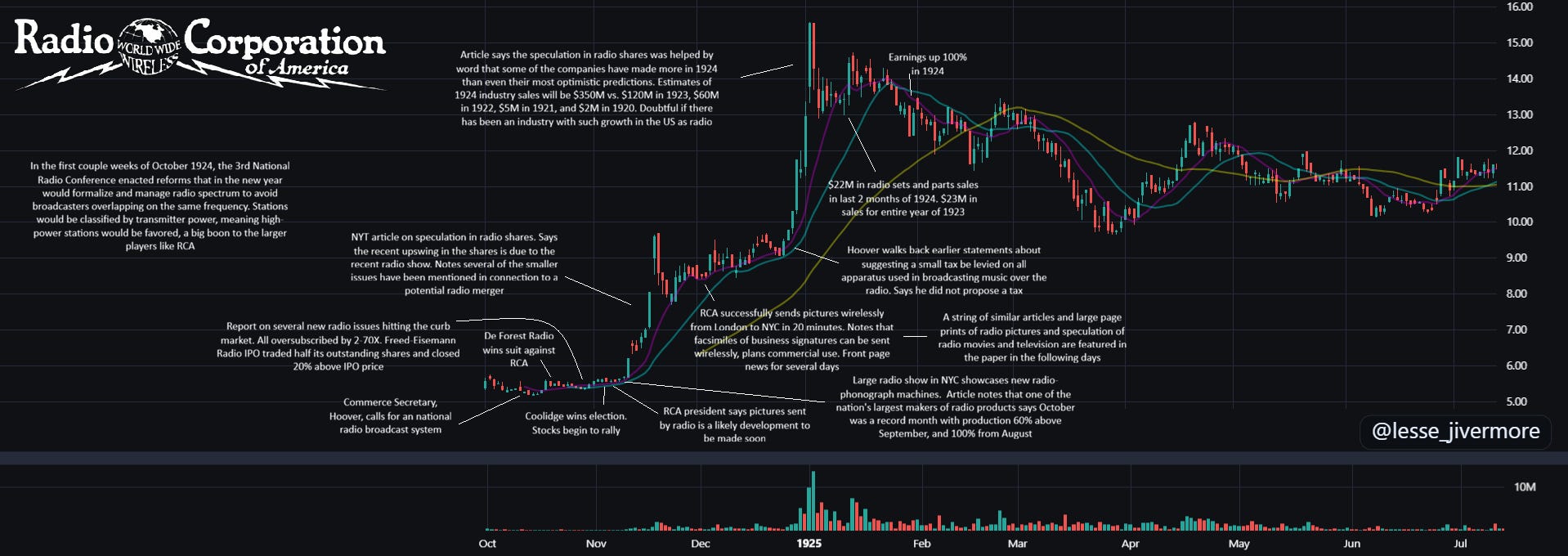
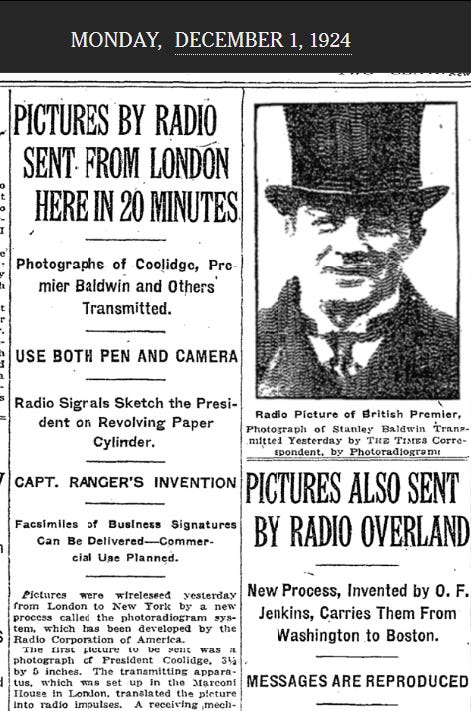
During this rally the entire market roared to life with big moves in not just radio stocks, but motor stocks, rubber stocks, food stocks, and utility stocks. Radio was of particular interest as the previously mentioned radio show in NYC was credited with boosting interest among the radio shares. There were also several successful tests of transmitting pictures wirelessly across the Atlantic Ocean from London to New York in 20 minutes by RCA and Marconi. It was quite a sensation and the news of these events was plastered on the front page of the NYT multiple times. There were full-page write-ups about the meaning of this event and how soon television and other commercial applications would follow, greatly benefitting the radio industry.
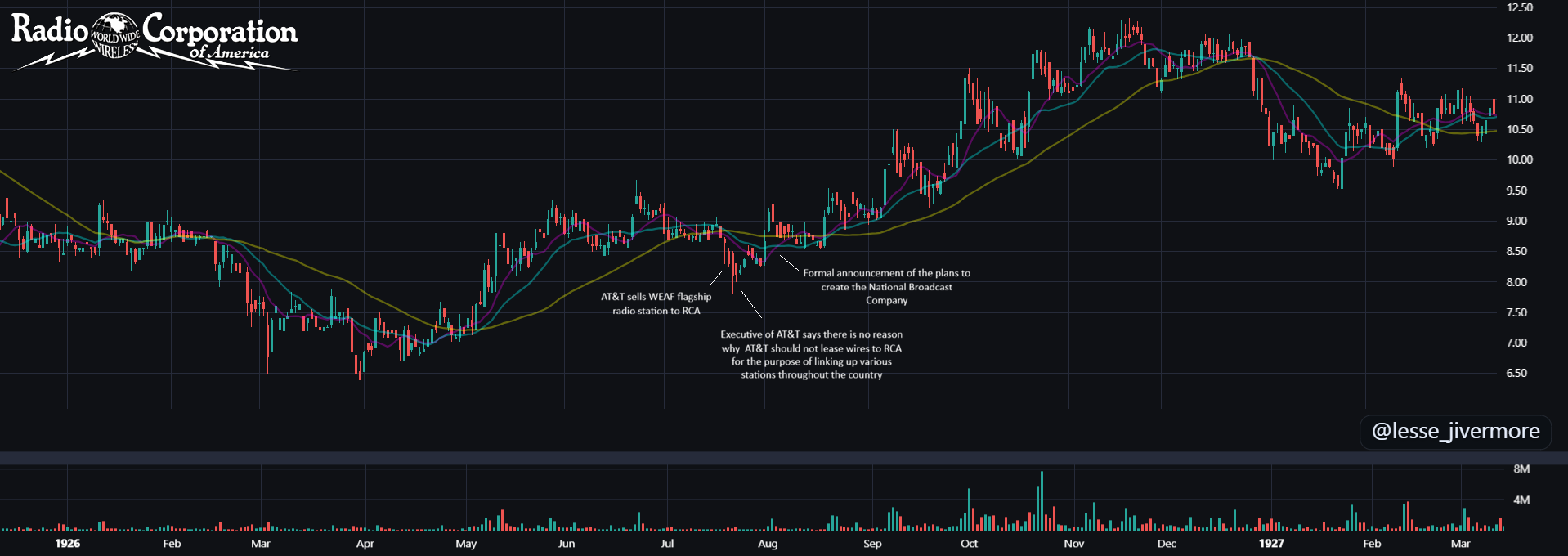
A flurry of new radio companies hit the market, all more speculative in nature than the last. Some increased 100%+, some less so, but they all saw a big jump in activity. But shortly after the new year with the last upward charge by the group, radio shares collapsed and many of these speculative issues faded into obscurity. Even the leader, RCA, continued to drift lower and lower until it hit its low in early 1926, falling about 60% from its 1925 peak.
While 1925 and 1926 were breathtaking breakout years for groups like the motor stocks which featured General Motors, Chrysler, and Packard that saw spectacular gains made, RCA and the radio group would languish for multiple years, either trading downwards or sideways. Radio itself was still as popular as ever. New uses were being dreamed up, and developments were continuously being made in the industry. But several developments emerged that would have an enormous impact on the industry in the following years.
Sound technology was constantly making new strides, but major breakthroughs occurred in 1925 that had a ripple effect across several industries. Western Electric, a subsidiary of AT&T, had developed a new method of recording music. Previously, music was recorded acoustically by playing into a large horn that would vibrate a needle that etched into a wax recording plate. Western Electric’s new method used electric microphones to record music, significantly improving the quality of sound recordings. Gramophone, radio, and movie companies were extremely excited about these developments as their products all relied heavily on sound recordings. Although movies at the time didn’t use recording equipment for recording actors’ voices, they did play music alongside their movies, and this new technology would lead to future breakthroughs for their industry. As music and radio tech continued to make gains in 1925 and 1926 another breakthrough came in 1926 for RCA specifically.
A long-standing player in the radio field, AT&T, owned radio stations, experimented with the first “toll broadcasts” which were essentially just ad-funded radio programs, and they figured out how to create live real-time nationwide radio broadcasts through their infrastructure of telephone cables and radio stations. But AT&T wanted out of the broadcast business to focus on its telephone monopoly. They sold their network contracts and their WEAF station in NYC, the largest in the city, to RCA. As part of the deal AT&T would lease access to its telephone lines to RCA. With access to AT&T’s telephone lines for long-distance transmission, RCA decided to link up their major national stations to create the first national broadcast chain in the country. RCA along with its parents, GE and Westinghouse, formed the National Broadcast Company, or NBC. NBC essentially became the broadcasting arm of RCA and it gave them an incredible amount of power in the radio industry. From formation in 1926 to the crash in 1929, NBC would grow its network from 19 to nearly 70 stations.
In mid 1926 radio was improving on all fronts. Not only was the radio itself and the recording of sound improving, but many branches of radio-derived tech were improving as well. Here is an excerpt from an article on the advancements of radio from the time:
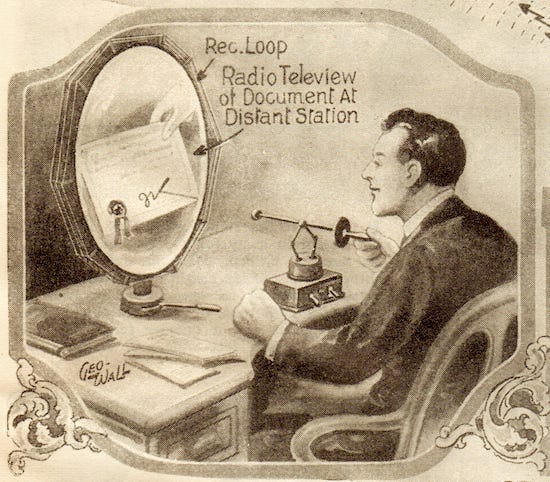
“Facsimiles of contracts were shot to Europe by radio, autographed and returned to demonstrate the quick method of handling emergency business abroad. A European singer or batter who becomes famous overnight can by radio be signed up by an American promoter in the course of a morning. An impulsive American publisher can in an hour or two contract with a King for the royal confessions, and a quick-thinking producer can in an equal space of time obtain the stage and movie rights on the next explosion of turpitude in high life.”
They were essentially talking about the original version of DocuSign in 1926. And this wasn’t a fantasy of the future either. There were actual contracts being signed with the aid of this “photoradio” device. In 1926 a commercial service was set up to send documents, news, and other information between London and NYC. The device was also installed at the Waldorf hotel for businessmen to send and receive important documents. The idea of television not being too far off into the future was also popularized around this time in 1926.
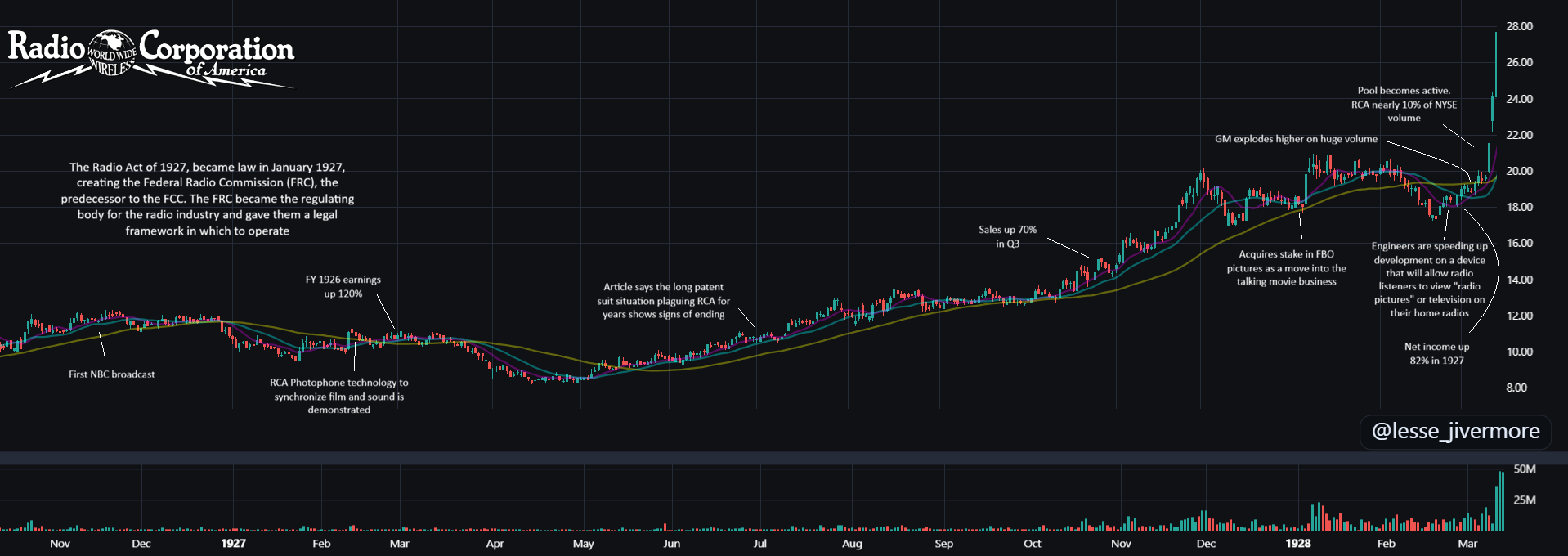
But radio wasn’t done expanding its uses into other fields of business. By at least 1926, radio had been working on improvements to incorporate sound into movies. And in 1927, along with its parent companies, RCA held a successful private demonstration of a new technology that allowed for the synchronizing of sound and film. This new “Photophone” technology was instrumental in allowing the flourishing of talking movies. Although Western Electric had their own version, Vitaphone, which won the race to commercialization and was used in the first talking movie, The Jazz Singer, in 1927, it was inferior to RCA’s Photophone which won out over time. RCA’s tech was an electric process whereas Western Electric’s was more mechanical as it used large records that played over the film. This ended up causing skips. The sound would become desynchronized if the motor slowed down, and the bulky equipment increased costs to ship films compared to RCA’s Photophone.
1927 also saw the establishment of the Federal Radio Commission (FRC). The FRC was the predecessor of the modern FCC and it was created to regulate the radio broadcast industry. The Radio Act of 1927, which created the FRC, also gave a legal framework for the industry to work within, making it more clear what they could and couldn’t do, and like a lot of regulation, made it harder for late-comers to gain market share. This was good news for RCA.
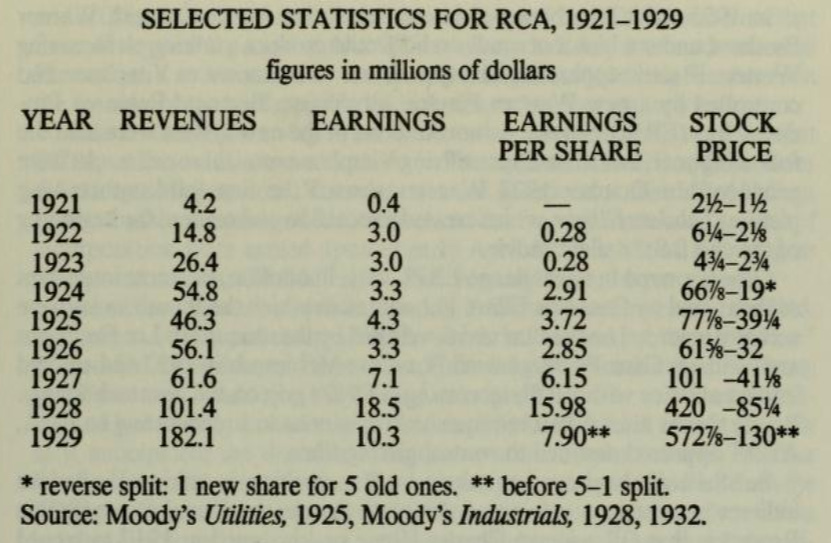
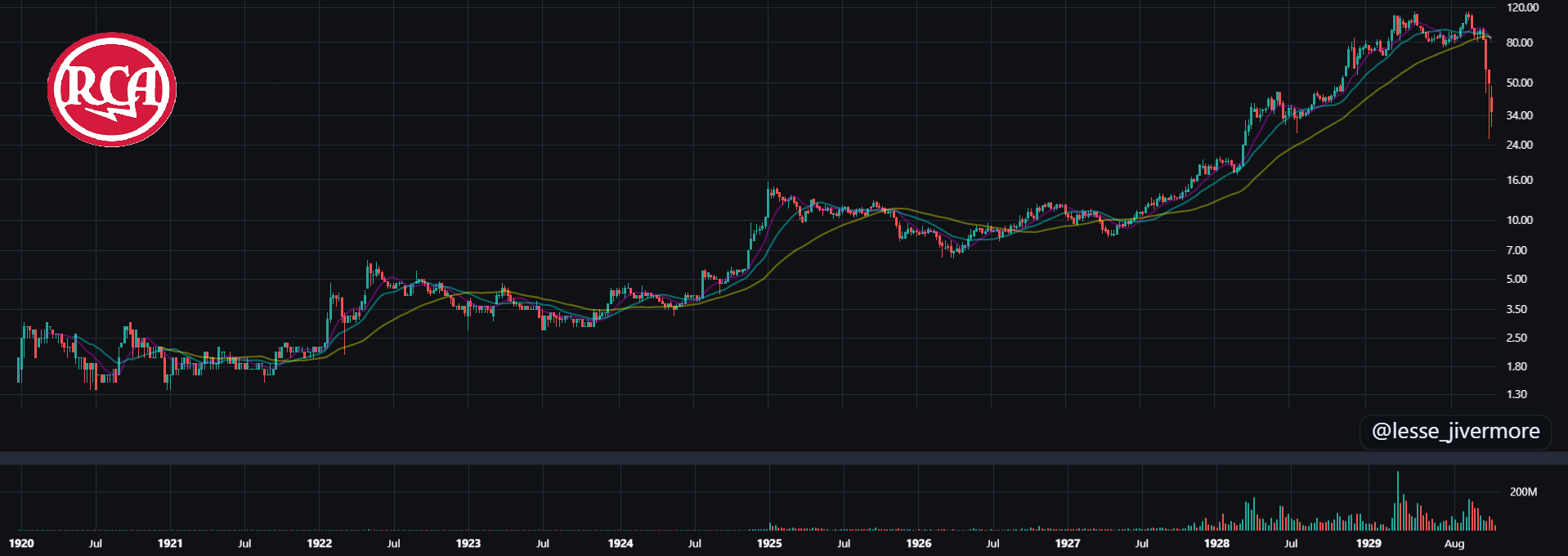
As far as the stock was concerned, 1928 would be the big year for RCA and many others in the market. RCA’s stock saw a roughly 10x increase in liquidity between October and December 1927 while price increased about 100%. Then in early March, General Motors, the undisputed leader of the bull market, broke out and shot up to a new all-time high on massive volume. Animal spirits were high and rising, foreshadowing what was to come in the radio group. On March 9, 1928, RCA exploded out of its base, blasting through the $100 (pre-split) level on volume amounting to over $30M in volume. Keep in mind that this was at a time when a stock trading $1M in a week would have been sufficiently liquid for most traders, and anything trading $1M a day would have been considered quite liquid. This is when RCA went from being an average group leader to becoming the dominant speculative king and the face of the bull market.
From this point on, radio stocks began to make a comeback. Many of the speculative issues listed on the Curb were no longer listed by this time, but some of them were still around and new ones came to replace the old ones. Some made some good moves while others were still mostly illiquid and uninspired. One stock, for example, Hazeltine Corp., rose from $8 to $70 between 1928-1929. However, it was quite illiquid and didn’t make for a great trading stock even though the magnitude of the move was so great. Also around this time, some of the stocks in the broader music or entertainment category were tightly linked with the radio group. Stocks like the Victor Talking Machine Company and Columbia Graphophone were involved in sound technology more broadly and were looking for ways to survive past the dominance of radio.
One interesting fact to note that is especially relevant for the radio stocks in the 1920s is that although RCA was listed on the NYSE and remained the only pure play radio stock listed on that exchange until 1928, and the Curb Exchange had a number of radio stocks as well. A lot of the action in radio stocks between 1928-1929 actually happened on the Chicago Stock Exchange (CHX). The CHX was a much smaller regional exchange earlier in the decade, but it saw tremendous growth in 1928-1929, like other local exchanges. Many of the radio stocks of the late bull market were traded mostly in Chicago, but there were notable radio stocks in Cincinnati and San Francisco as well.
As previously mentioned, just days after GM broke out in March 1928, RCA made its own explosive move, breaking out over $100 and rising over 60% in just four days. The move in 1924 was big and on large volume, but nowhere near what it was doing in 1928. It became the only stock since the beginning of 1926 that could even come close to contending with GM as the undisputed leader of the market. RCA was likely the second or third most liquid in the entire market in 1928 next to GM and US Steel.
While RCA was the leader of the radio group for the whole duration of the bull market, it wasn’t really until March 1928 that it became a truly significant part of the market, trading sideways from 1925-1927. It can’t really be overstated how much RCA’s move captivated the market. The only modern-day parallel is the move in NVDA in 2024 (although, technically, I would argue that the stock itself was much more akin to YHOO in 1999 as it was more of a speculative leader).
1928 was the breakout year for smaller radio stocks on other exchanges as well. This is when they began to pop up all over the curb and in out-of-town exchanges. It’s also when we see the first group of other radio stocks list on the NYSE. Kolster Radio listed in July and became a feature for a brief time. Then Crosley Radio listed early in 1929, but after it had already moved 1,000% from the lows.
RCA would eventually move from a pre-split $100-$570+ between March 1928 to its 1929 peak. During this time, most of the smaller radio stocks would fall apart in early 1929 along with many others. A lot of the former leaders struggled into 1929, having made their big moves in 1928. The utilities group showed up in a big way in 1929, completely dominating other groups. RCA was boosted by its deal to merge with Victor Talking Machine Company early in 1929, but it was a fairly choppy move to get to its peak. However, many speculative issues did make good moves in 1929 as the euphoria in the market came to a climax.
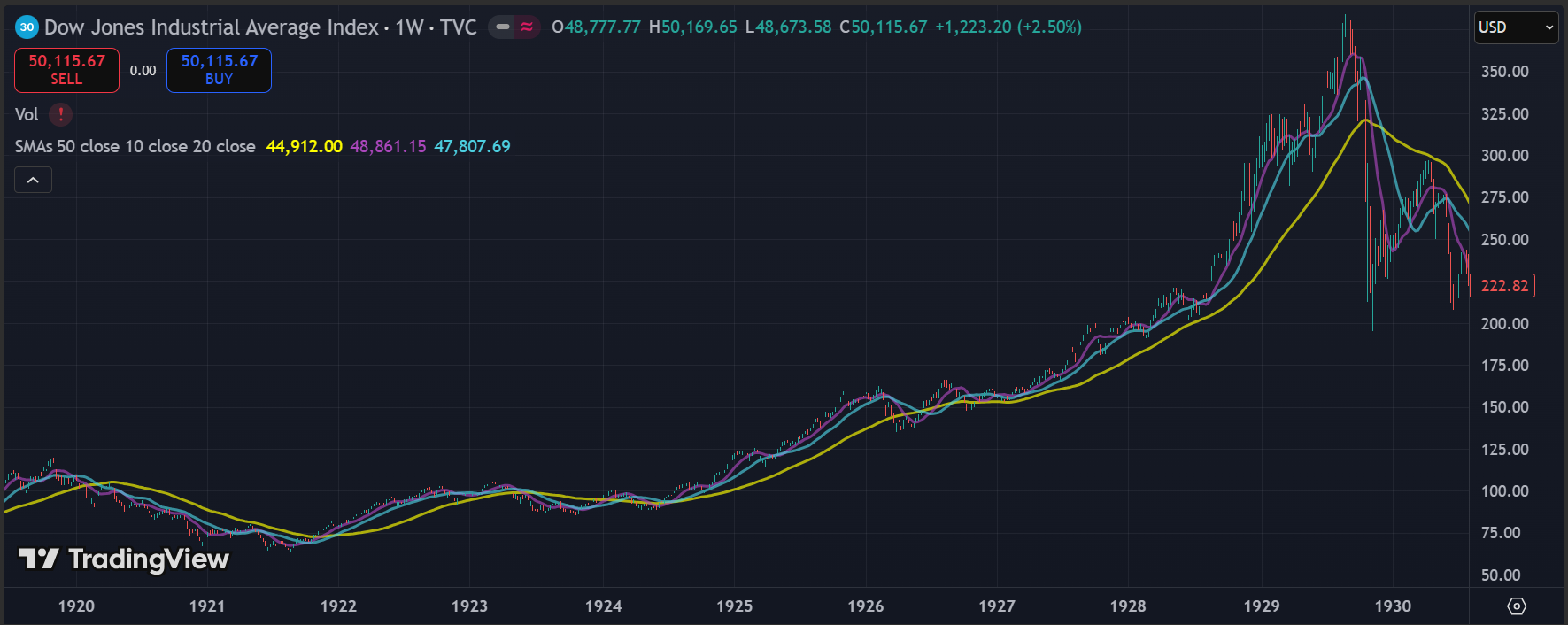
RCA and many other leaders based out for much of 1929, tanking and quickly recovering on bad news mostly concerning higher call money rates (short-term rates charged on broker loans secured by stock collateral) and other financial news. RCA and many others that had been holding up well began to break in September 1929 before the ultimate crash in October. From its peak split-adjusted high in 1929 of $115, it fell to around $2 a few years later—a fate shared by almost every other stock in the market.
Now, with all that out of the way, let’s dive into some of the charts of these stocks to get a sense of how the market was playing out for the radio group.
Radio and Phonographs
I’ve already touched on this here and in a previous post, but radio and the phonograph business were linked quite tightly, especially with partnerships like that of RCA and Victor. The pair teamed up to produce dual radio-phonographs. The record company, Victor, gained footing in the radio space while promoting their signed artists on the radio. RCA was able to get access to Victor’s popular artists to play on the radio.
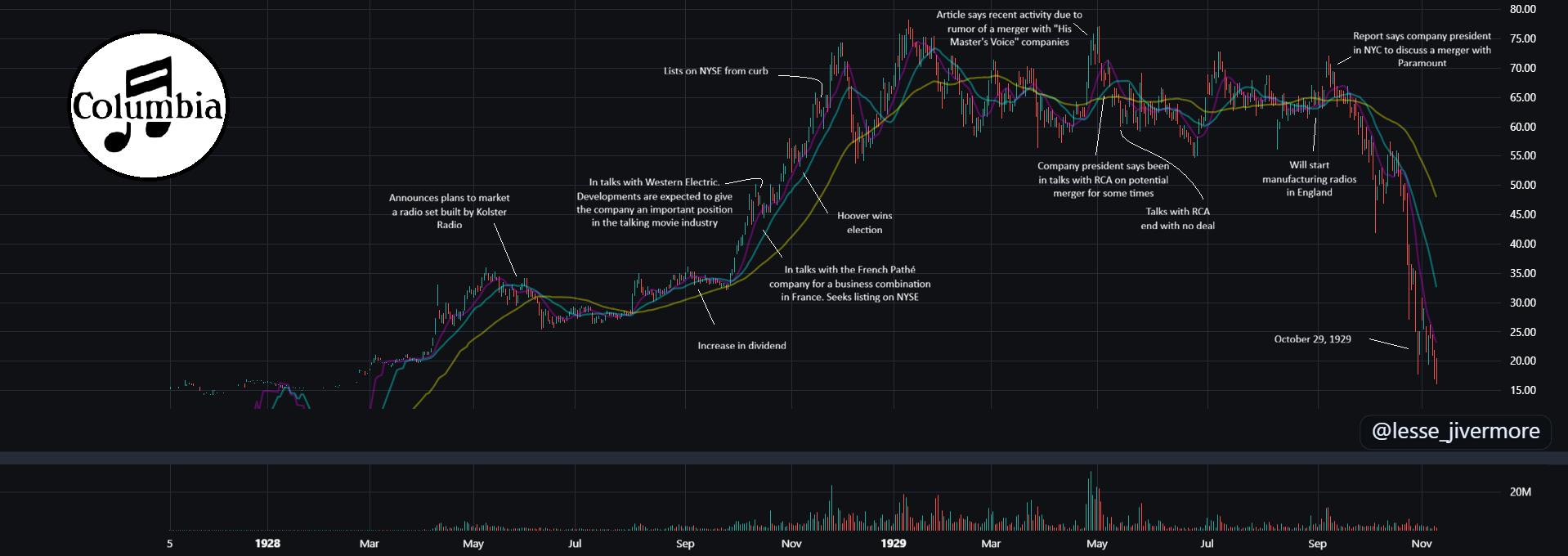
There was another similar pairing of companies from that time. Columbia Graphophone, the company that would go on to become the record company known as Columbia Records, partnered with Kolster Radio to produce dual radio-phonographs. These dual radio-phonographs appear to have been quite popular at the time as seen from both written accounts and from the fact that multiple big players got in on the act.
Columbia was a direct descendant from one of the original Edison patents for the phonograph and earliest players in the industry. They were probably the second biggest phonograph company after Victor in the early 1920s. But due to financial issues after the First World War, they declared bankruptcy and were stricken from the NYSE. Columbia was originally Columbia Phonograph. But after their bankruptcy in 1923, their assets were taken over by their British subsidiary, Columbia Graphophone. After several years, the British Columbia Graphophone listed its shares on the Curb Exchange in late 1927 and became a market leader within a year. Their shares on the London Stock Exchange rose well over 2,000% during the bull market.
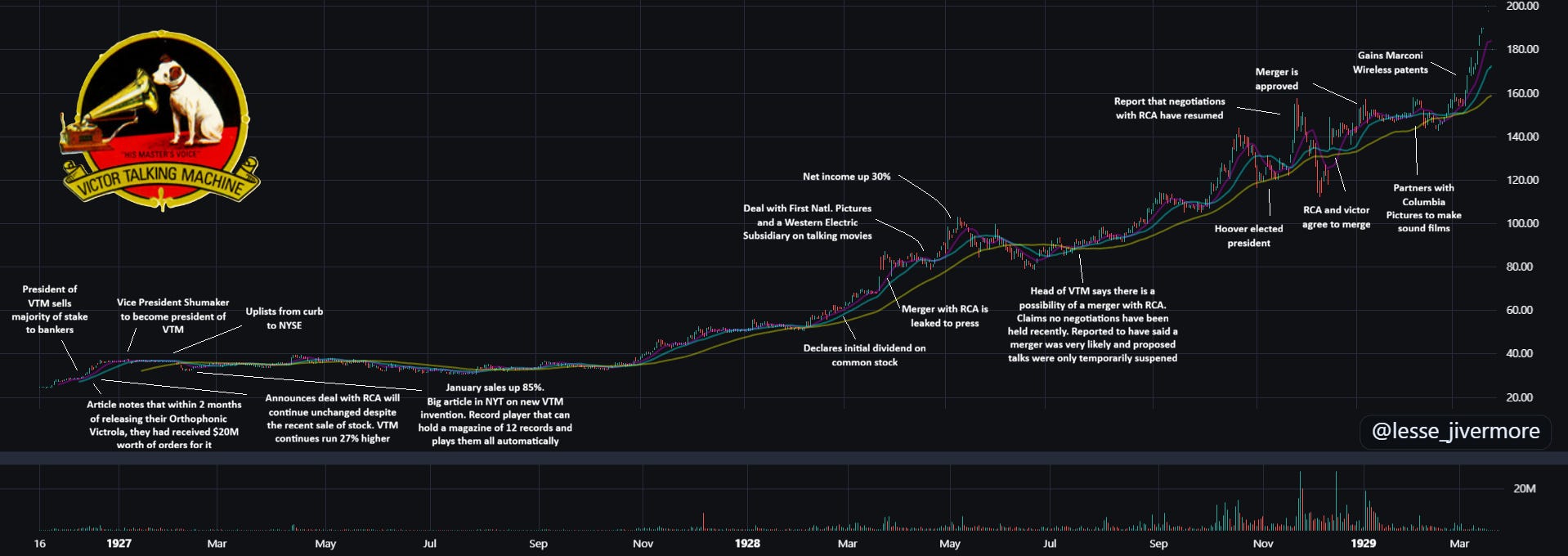
I already went into Victor in a previous post, so you can check out the RCA-Victor merger post for more detail. But Victor was the top phonograph company of its time. After running into difficulties like Columbia in the first part of the decade, Victor partnered with RCA to create dual radio-phonographs. Eventually, the pair merged in early 1929 at the peak of the mania.
The company had tremendous brand power which would’ve been recognizable to most people in the country. Their contracted artists were very popular and made appearances on the radio which boosted their brand and products even more. The company experienced a huge turnaround from 1925 to their merger with RCA in 1929

Television
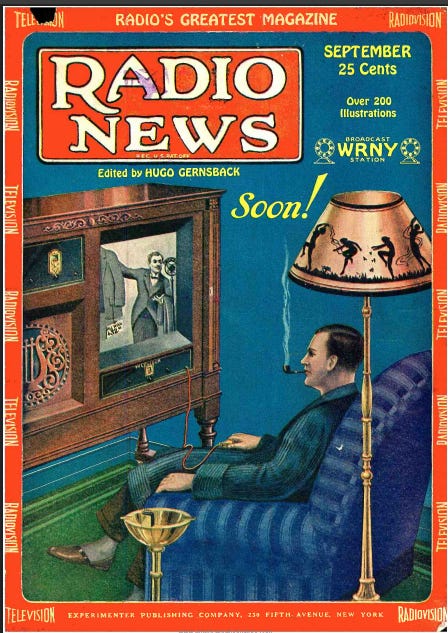
Although television had been mentioned throughout the decade as a potential next phase in the evolution of radio, it wasn’t until 1926-1928 that it really appeared to be much more of a possibility than a far-off fantasy. There were transatlantic wireless transmissions of “radio pictures” and demonstrations beaming movies into the homes of industry executives and members of the Federal Radio Commission. There was much talk of creating an apparatus that could be attached to a radio cabinet that would give consumers “radiovision.” Some people even put off purchasing a radio because they thought that radios would soon be equipped with television. Although the depression and subsequent World War delayed the commercial development of television, it loomed large in the hearts and minds of the public.
The futurist and founder/editor of Radio News and other works, Hugo Gernsback, controlled the radio station WRNY in New York. This station was closely associated with Radio News and his other publications and produced broadcasts on the content of the magazines and related works. In August 1928, WRNY became one of the first stations to provide regular daily television broadcasts. This was at a time when televisions essentially didn’t exist. There were no commercial television manufacturers and you basically had to build your own receiver in order to see broadcasts from WRNY. However, due to financial difficulties, the broadcasts shut down in 1929.
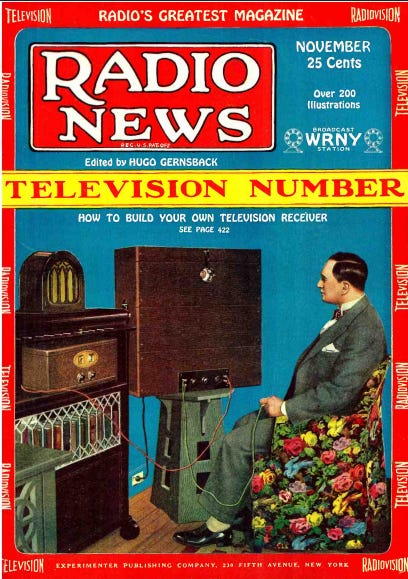
Television was seen as the natural successor to radio, and much of the gains would accrue to the radio companies. This makes sense as the technologies were fairly similar, could be housed in similar cabinets, could be manufactured in the same factories, required many similar parts, could be broadcast over the airwaves, and so on. And this is exactly what happened. NBC and CBS which both began as radio broadcast networks in the 1920s, later developed into massive television and media companies that dominated for decades. But television was more of an intriguing idea rather than an actual part of any company’s business at the time.
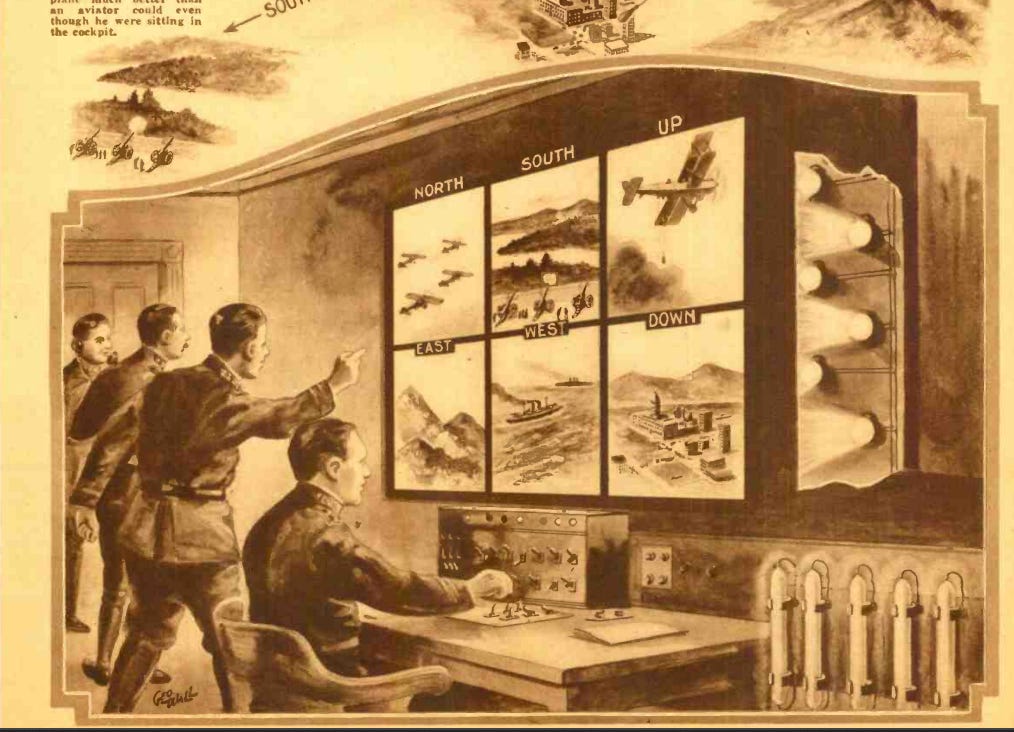
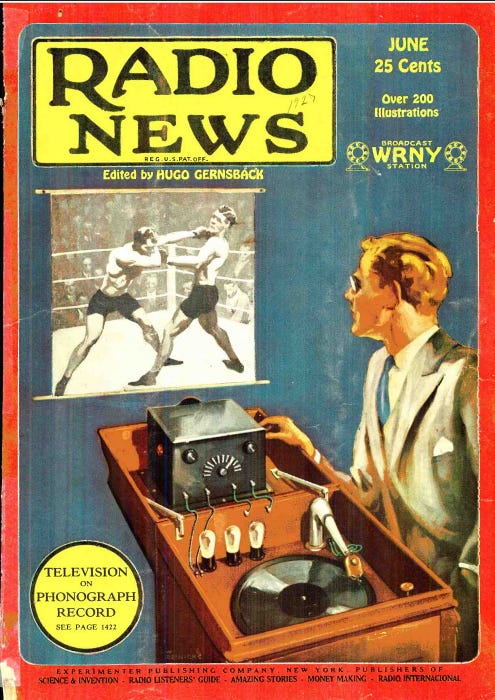
As far as I could find, there was only a single stock that could be considered a television stock. Not because other companies weren’t working on television, but because for most radio companies TV was merely a research project. However, there was a stock listed in Chicago that took a page straight from the meme stock playbook and named themselves US Radio & Television in order to ride the hype around the new technologies.

Penny Stocks
Many of the radio stocks listed on the Curb Exchange were primarily of low quality and low price. Most of them were small niche radio set manufacturers, electronics and radio parts manufacturers, or radio tube (vacuum tube) manufacturers. A lot of the smaller radio and radio parts companies were operating in a legal gray zone. RCA, at its core since inception, was a patent pool. It owned countless patents related to radio and radio parts. Consequently, many of these smaller firms selling radio tubes and other parts were nearly perpetually involved in litigation. This, coupled with the fact that most of these companies were rather small, meant that they were often in a precarious financial situation and not of what would have been considered “investment grade” quality. This is evident in the charts of these stocks that feature long periods of low activity interspersed with short powerful bursts of 500%+, followed by a quick, inevitable collapse.
It is worth mentioning that although many stocks were bought on heavy margin, stocks were generally only marginable if they were at $10 or more per share. So cheaper stocks weren’t always traded on heavy margin the way RCA and others were.
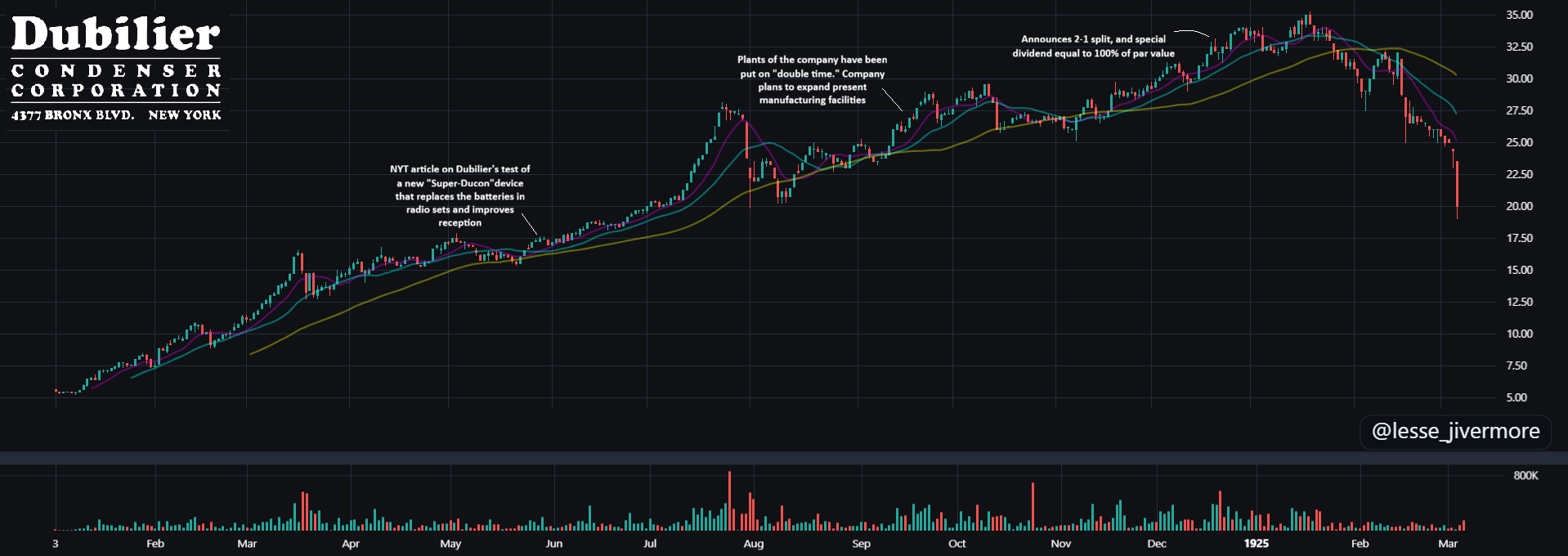
Dubiler Condenser and Radio was a small company that mostly produced capacitors for radio sets. Not a lot of information was available on this one. I found no relevant news for the period on the chart shown.

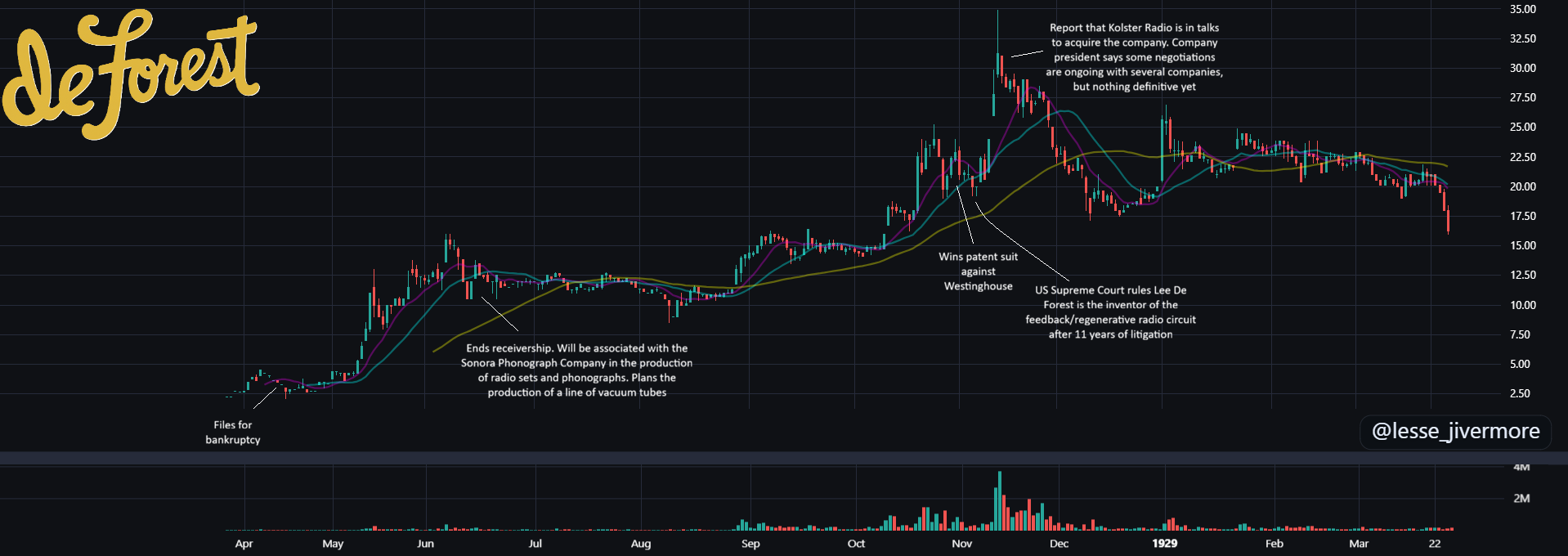
De Forest Radio, a maker of radio tubes, was founded by Lee De Forest, a pioneer and deeply-respected inventor in the field of radio. Unfortunately, he was a better inventor than he was a businessman. The company was constantly involved in legal disputes and ended up going bankrupt multiple times, along with its founder.
In 1928, the stock ran from $2 to $35 amid the boiling 1928 market, radio hype, exiting receivership, and the resolution of an 11-year lawsuit with Westinghouse.
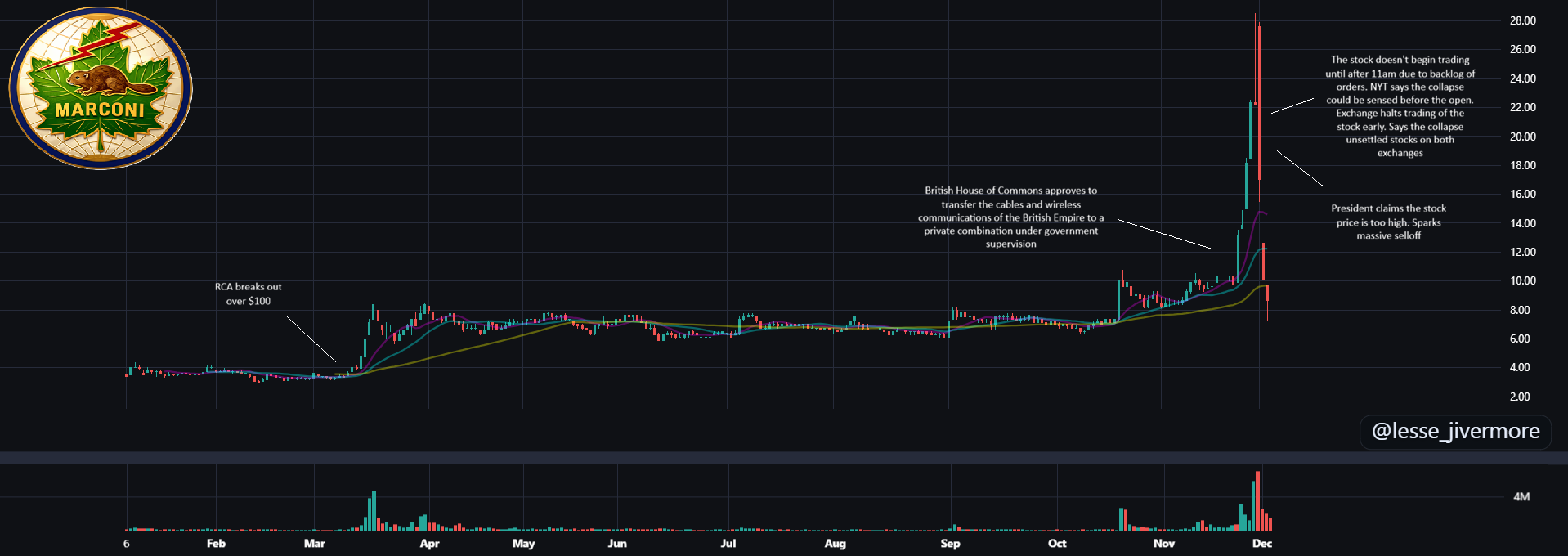
This next stock is a fascinating one. Marconi Wireless Telegraph Company of Canada, or simply Canadian Marconi, was the Canadian subsidiary of the British Marconi parent company. They produced radio sets, parts, and had a hand at broadcasting before the industry was centralized by the Canadian government. However, they did own a broadcast station in Canada.
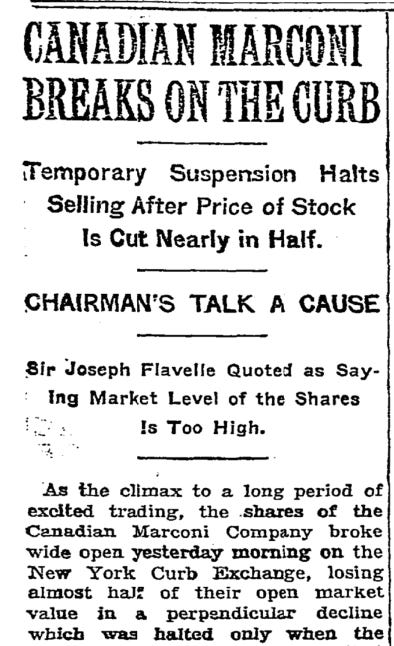
Then, in November 1928, the British government decided to turn over the communications infrastructure of the British Empire to a private consortium with government oversight. The news of this sparked a furious rally in Marconi shares which rose 150% in five days. The next day, orders had built up before the open and trading in the stock was postponed for at least an hour after the rest of the market had begun to trade. The newspaper noted that the “collapse could be sensed before the open.” The stock opened up over 20% higher and immediately collapsed. Reports came in that the company’s president had said the stock price was too high, and the stock agreed. Trading was halted early in the stock that day. The price imploded by about 75% in just three days.
Canadian Marconi moved from a low of $0.79 in 1927 to a high of over $28—a more than 3,000% gain.
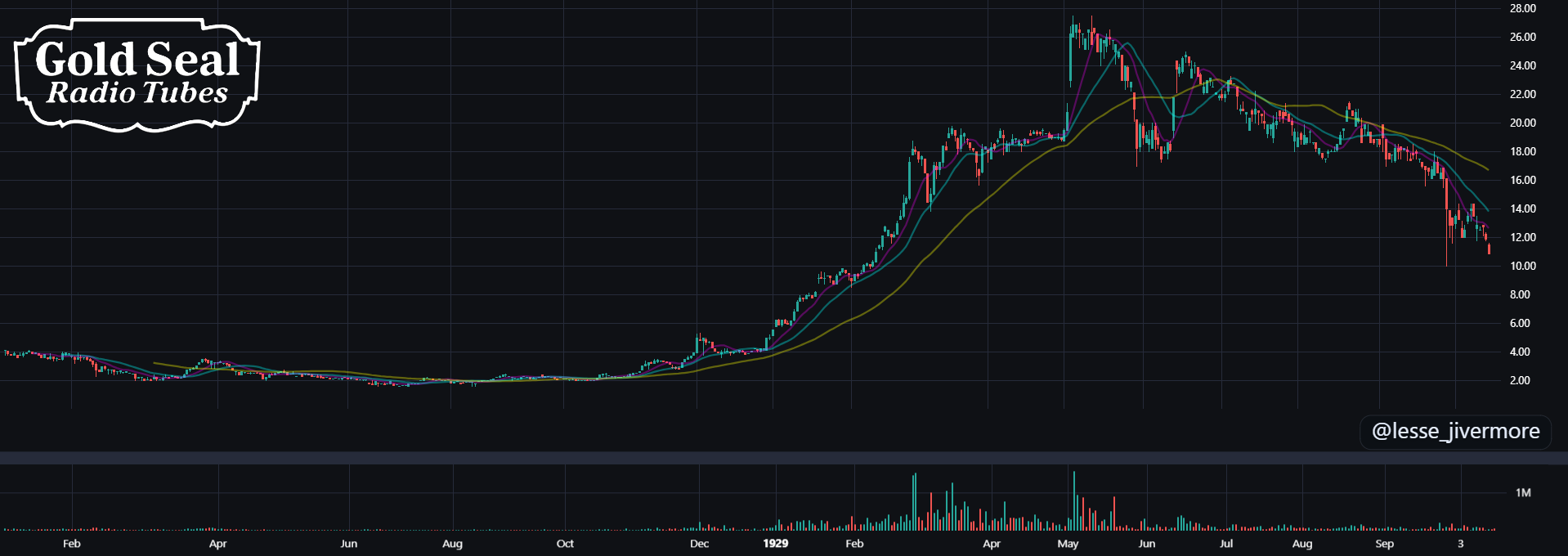
Gold Seal Electrical was another penny stock radio tube company that ran up over 1,000%. I couldn’t find much info except for the announcement of an acquisition and that they were booked to capacity through 1929 as of at least a full week after the peak in the stock.
Out-of-Town Exchanges
From 1928—1929 many of the regional stock exchanges outside of NYC saw huge growth in their listings and traded volume. There were exchanges in Detroit, Boston, Cincinnati, Denver, Los Angeles, San Francisco, Philadelphia, Baltimore, Chicago, and more. Most of these smaller exchanges were still thin compared to the New York exchanges, but some stocks in certain exchanges were decently liquid. The best of the stocks listed on these exchanges were typically those in the automobile, utilities, or radio group.
When mentioning hot radio stocks of the period, most people don’t realize that a bulk of them weren’t even listed in New York at all. Many made most of their moves while listed on smaller exchanges. A handful of them eventually did list on the New York Curb exchange or the NYSE, but this was usually after a 500% run had already been made. If they listed in late 1928 or 1929, odds are they went straight down once they began trading in New York, or at least after an initial pop after their NYSE listing.
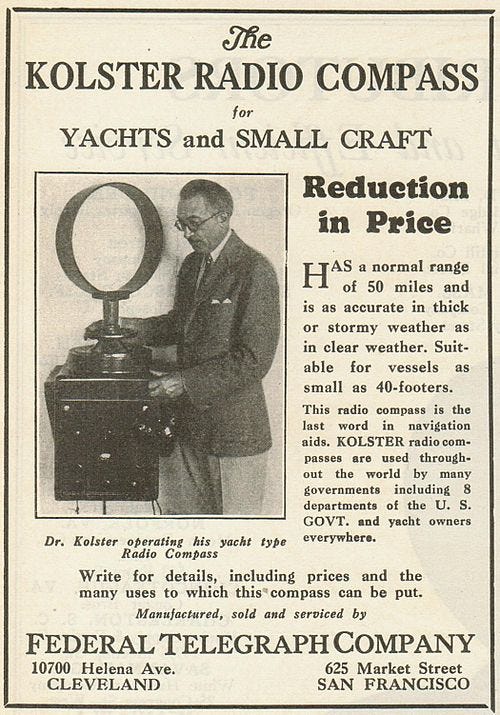
Kolster Radio was originally listed on the San Francisco Stock Exchange as the Federal Telegraph Company, and known later as Federal Brandes. Their Kolster brand of radio sets were so popular that they decided to change the company name to Kolster Radio to embrace the hype around the radio industry in another classic meme stock play.
Late in 1928, a few months after listing on the NYSE, Kolster became a sensation on the exchange for a brief period as one of the more liquid stocks. I believe Kolster was the second pure play radio stock to be listed on the NYSE, a full four years after RCA.
It isn’t clear what separated some of the radio stocks that held up from the ones that imploded in late 1928 and into 1929 since financial information and news are rather sparse for many of the lesser-known stocks. But an interesting fact to note is that in May/June 1929 it was reported that Kolster was one of the few radio companies with a remote controlled radio that was showcased at the Chicago radio fair at the time. But this wasn’t enough to support its stock which had already fallen over 60% from its peak.
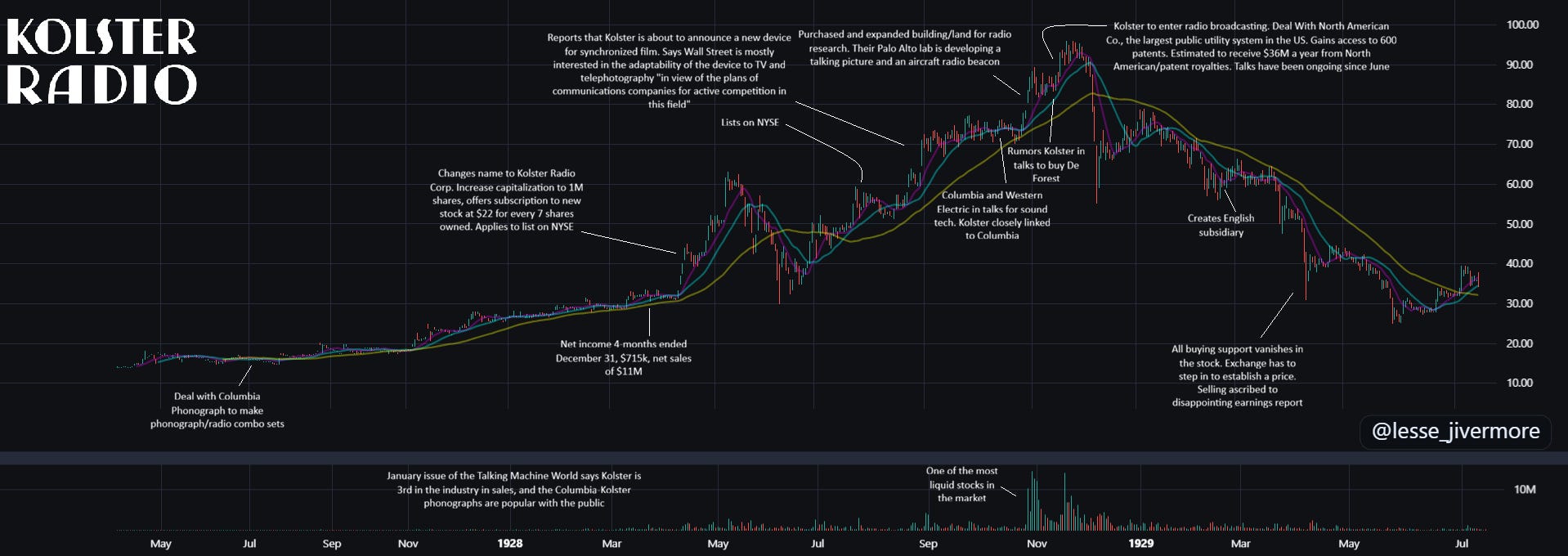
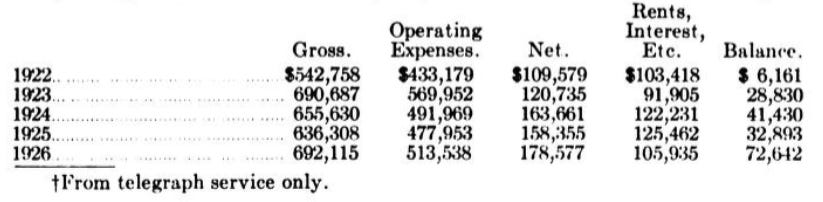
As you can see from the selected financials below, Kolster (Federal Brandes) was listed as having a “net” of $179k and “gross” of $692k in 1926. It’s unclear what these refer to since they were very loose with their terminology back then, often using income and revenue interchangeably. But if we are conservative and assume the “gross” is their revenue for the year, we can see that they experienced tremendous growth in 1927 as the revenue (recorded as “net income”) for the final four months of the year was $11M. Subsequently, the stock rose from under $10 in 1927 to about $95 in 1928.
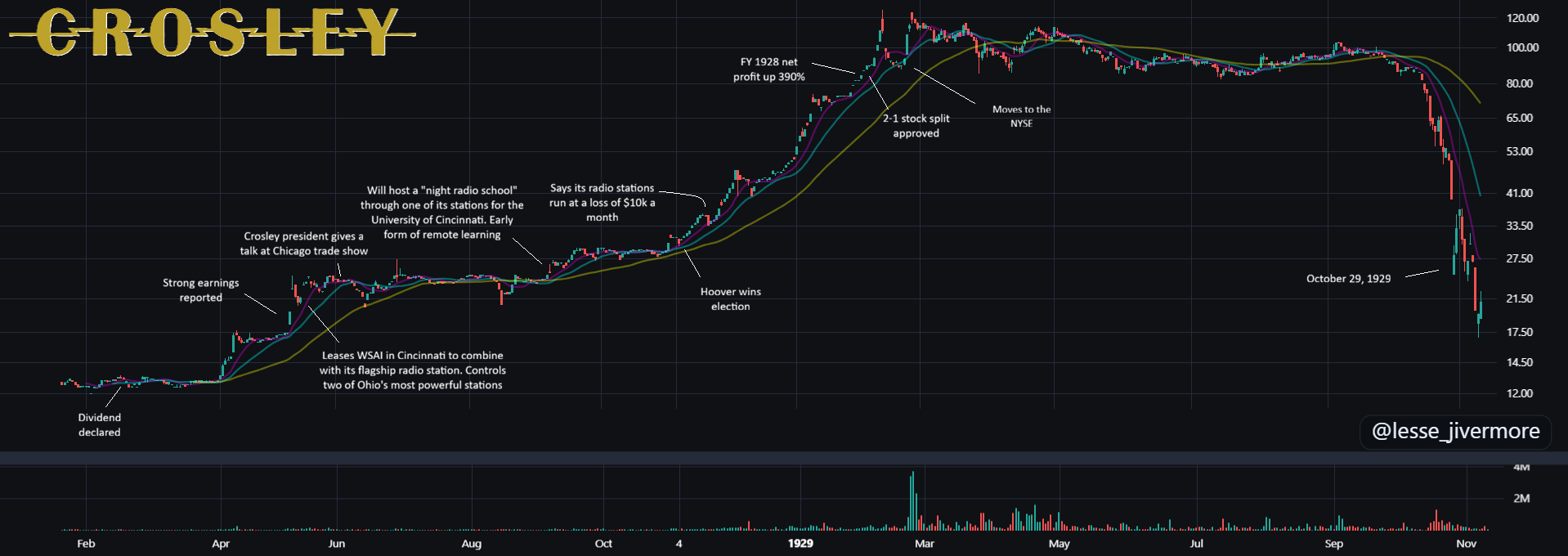
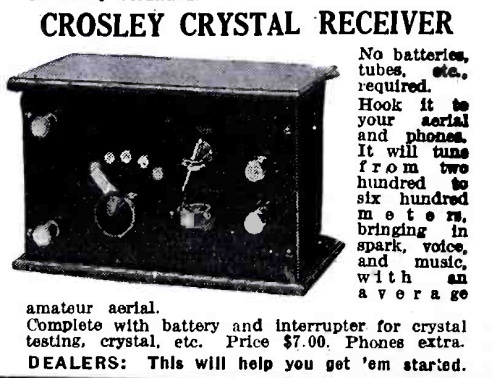
Crosley Radio was one of the largest manufacturers of radios in the 1920s. Their founder, Powel Crosley, Jr., was known as the “Henry Ford of radio” for their large-scale production of incredibly affordable radios. Many radios at the time sold for $75 or more, but Crosley had models that could be bought for under $40, and even a receiver for under $10. They entered the broadcasting business to advertise and sell more of their radios. Their flagship Cincinnati station would later become the most powerful in the country.
As it was listed originally in Cincinnati, it was quite thinly traded even though it was the star of the Cincinnati Stock Exchange until it listed on the NYSE to become the third pure play radio stock on the exchange. After listing on the NYSE volume quickly flooded into the stock, but by that time it had already risen 1,000%. It listed on the NYSE just as many radio and other stocks were turning over off their highs.
Crosley also experimented in early efforts at remote learning. They broadcast a “radio school” at night for the University of Cincinnati in 1928
LaSalle Street
Of all the out-of-town exchanges in the late 1920s, none rivaled that of Chicago. LaSalle Street was the Midwest’s answer to Wall Street, home of the Chicago Stock Exchange. Chicago was the most active and largest of these exchanges. Chicago was a growing center for manufacturing of automobile parts, meat and food packing, had utilities empires, and was a growing force in the radio industry. Most of the active issues in Chicago were in the automobile, utilities, or radio group. Several of the most interesting stocks of the decade were listed mainly in Chicago. Some of the stocks listed in Chicago were so liquid they would’ve even been considered highly liquid on the NYSE.
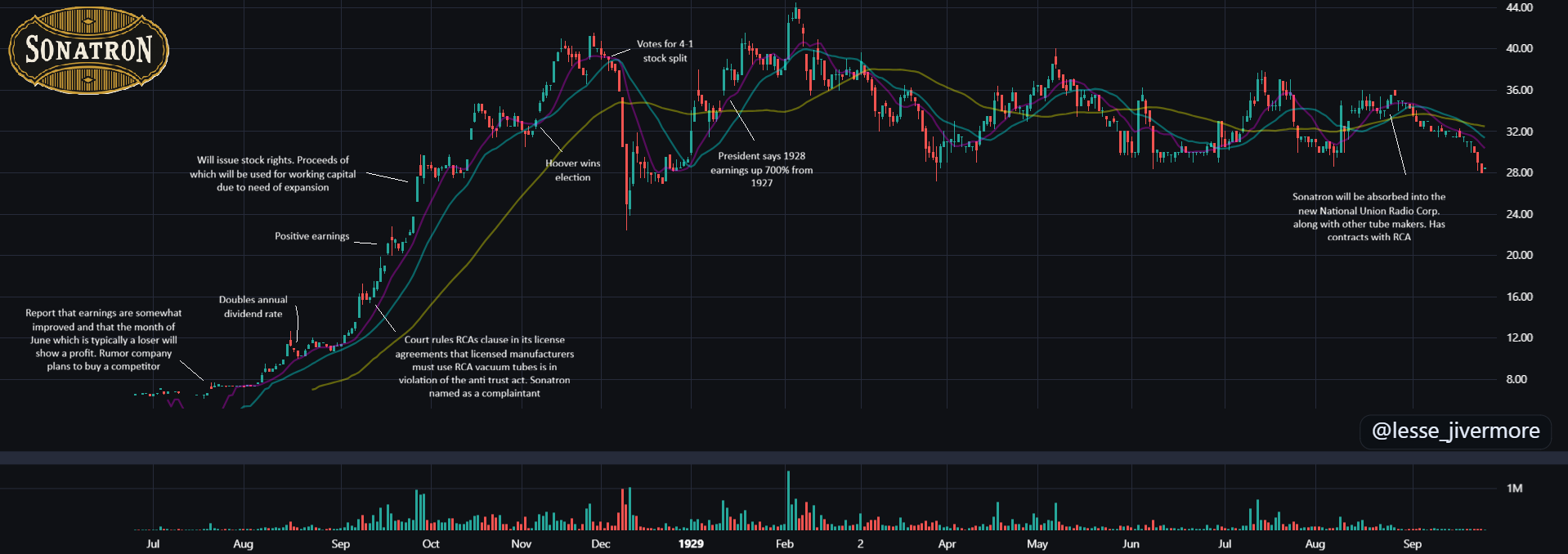
Sonatron Radio Tube was a manufacturer of radio tubes that listed on the CHX in 1928. Like many of the other tube companies, it was involved in ongoing litigation regarding RCA licensing issues. The independent tube manufacturers won a major victory, though, in September 1928 when it was ruled that RCA’s practice of requiring radio licensees to only purchase RCA radio tubes was deemed a violation of the Sherman Anti Trust Act. Sonatron was named directly as a claimant in the lawsuit.
Eventually they were folded into National Union Radio along with other tube companies in the second half of 1929.
I found absolutely no news on this stock. It appears to have been a small regional radio set or radio parts manufacturer. But whatever it was, it made a great move over 200% immediately after listing.

In terms of leadership in the radio group, these last two were the definitive leaders in the Chicago radio group. This first one is a stock many who have read How I Made $2M In The Stock Market by Nicolas Darvas, should be familiar with.
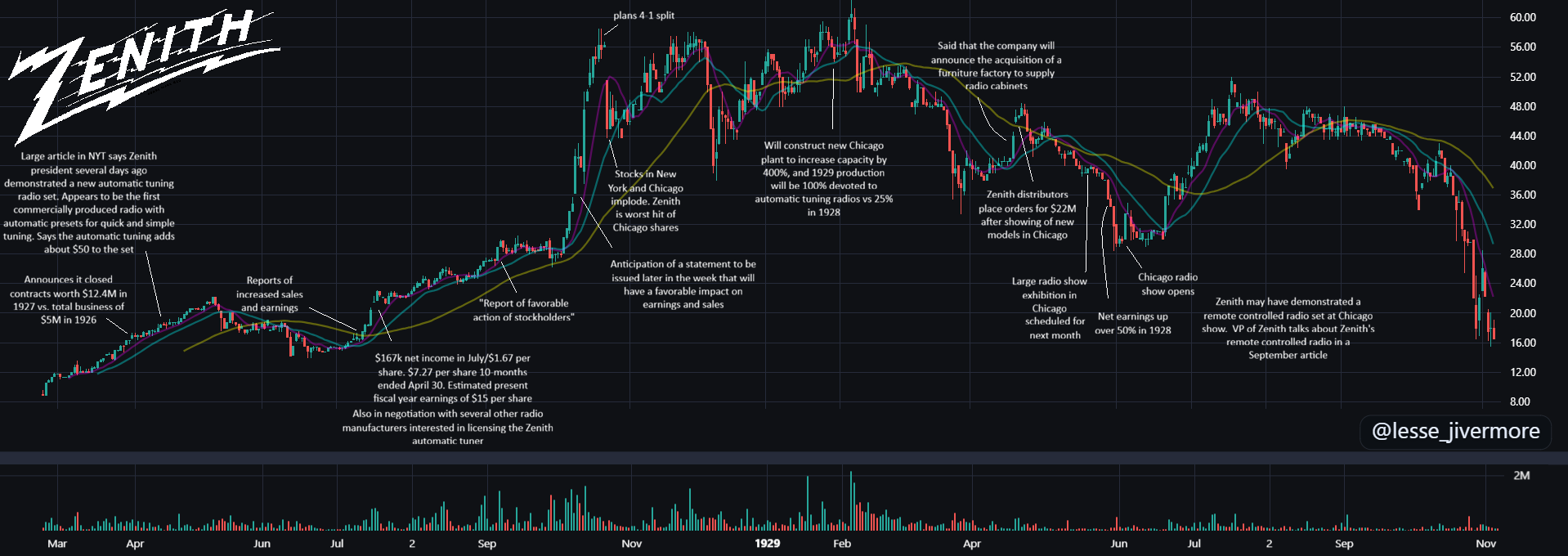
Zenith Radio went public on the CHX early in 1928. They were a recognized quality brand in the industry, but nowhere near the dominance of RCA or Atwater Kent (unfortunately wasn’t a public company at the time). But the business more than doubled in 1927.
Shortly after listing its shares, they introduced a new radio model that appears to be the earliest commercial radio set with “automatic tuning,” or presets. You would tune your radio to your favorite station, then press one of the six (or 10) preset buttons. Every time you press that button later, your radio would automatically go to the station you had tuned it to. Later in 1929 they introduced a remote control for their radios.
Like other manufacturers, they entered the broadcasting business, mostly as a source of advertising and driving more radio sales rather than as a primary part of their business.
Zenith eventually listed shares on the Curb Exchange, but like several other stocks that were dual-listed, their Chicago shares remained much more active than those in New York.
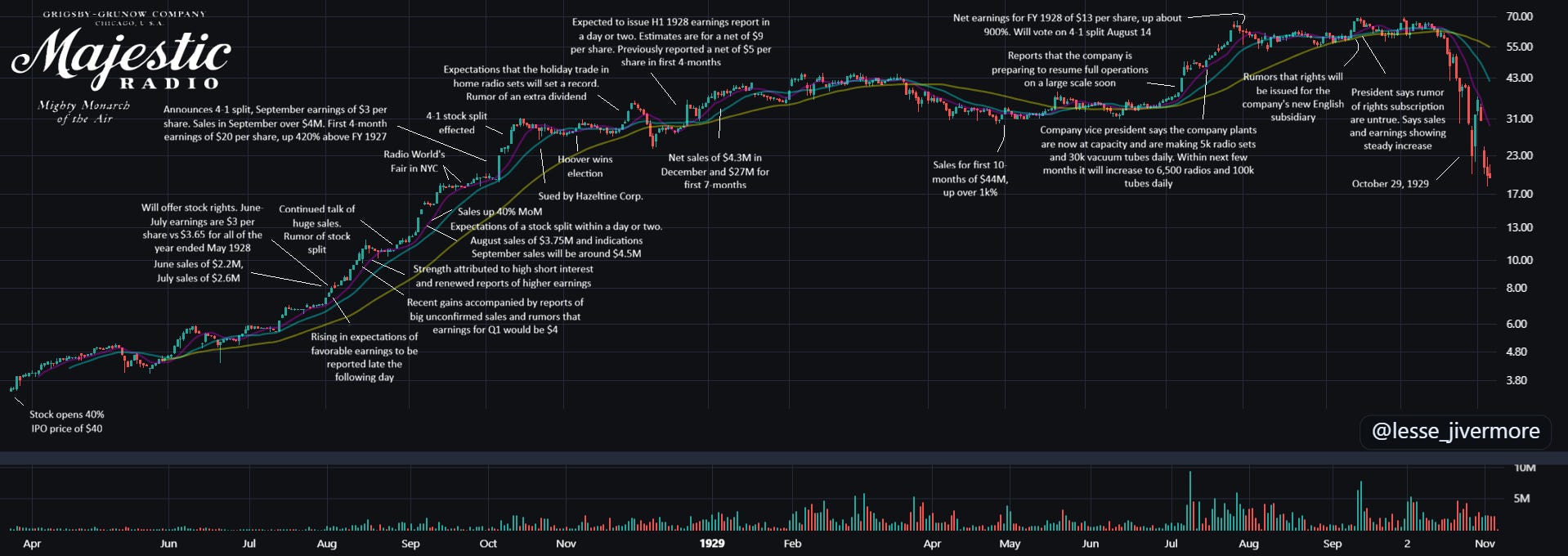
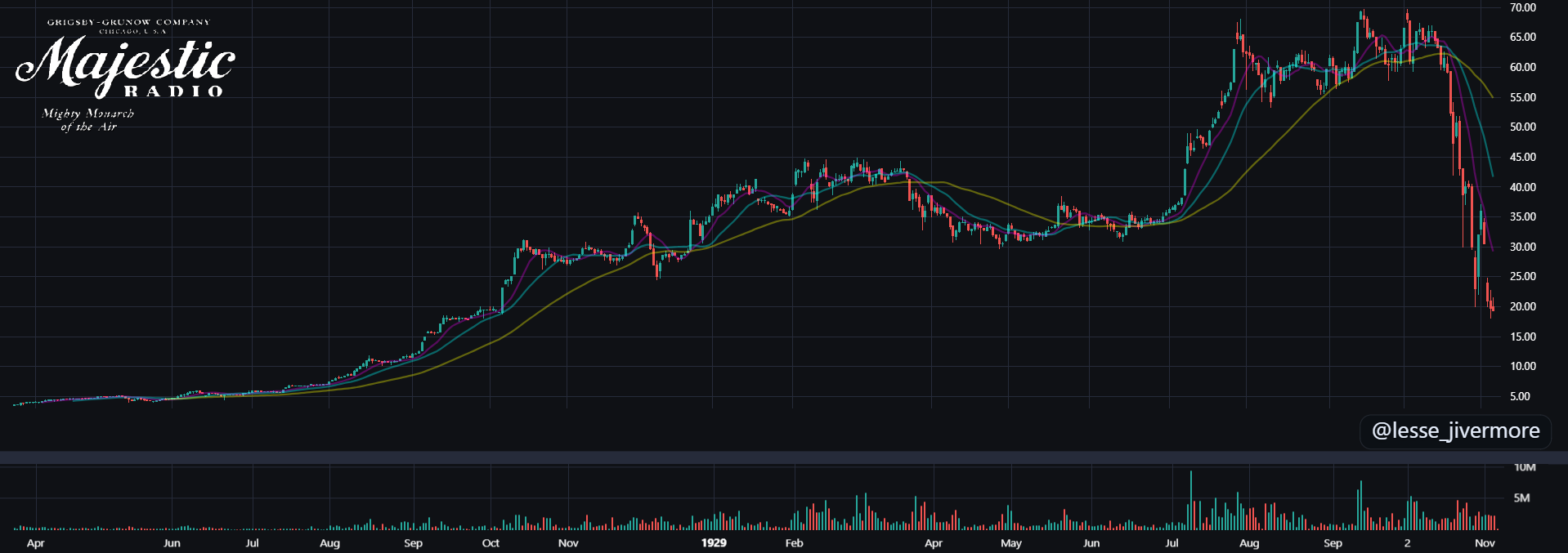
This last stock was referred to as “the wonder of Wall Street.” Grigsby Grunow produced the Majestic brand of radios, regarded as high-quality luxury radio sets. In five years they went from being a small, niche manufacturer of electrical components with a payroll of 40 to the #2 radio manufacturer in the nation, employing 6,300 people after a 1927 pivot into radio manufacturing.
The following is an excerpt from a 1928 Chicago Tribune article on the company:
“For instance, the Grigsby-Grunow company has no warehouse. Thirty carloads of raw materials come into the plant every morning and thirty carloads of completed radios go out every night. That means 3,200 complete radio sets turned out at the plant every day, and even this output is insufficient to supply the worldwide demand.
In order that adequate supplies be available, the company has five mills whose sole efforts are devoted to providing lumber for its needs. Approximately eighty-four tons of steel are used each day. The company uses enough wire for its super dynamic speaker to circle the globe daily. Sixteen thousand pounds of tinfoil are used every day. Approximately 12,000 pounds of paper are used daily for condensers. More than twenty tons of wax are used each day for the impregnating of condensers, chokes, etc. More than 5,000 pounds of aluminum are used daily.”
To say they experienced an explosion in growth would be an understatement. The IPO price was set at $40. The ultimate high in 1929 would be equal to $1,120 not accounting for the two 4-1 splits the stock had. The stock opened on the exchange no less than 40% above the IPO price. It was one of the most active issues on the CHX.
You can see by the notes on the chart what kind of growth they saw between 1927-1929. The earnings reported for just the first four months of 1928 alone were 420% higher than earnings for the entire year of 1927. Quality financial data from this era is very hard to come by, but at least in August 1928, sales were growing 40% month over month. Earnings by the first seven months of the fiscal year were up over 600% over the full 1927 fiscal year. The Radio News magazine said in 1930 that the company had sales of $5M in 1927, $40M in 1928, and $70M in 1929 (numbers were rounded). In 1930, they claimed they had 40% market share of US and Canadian radio sales.
Grigsby shares were eventually listed on the Curb Exchange, but although they were actively traded in Chicago, they were barely touched in New York for whatever reason. Grigsby (and others) would have 20k shares in volume in Chicago while their New York-listed shares had only a few hundred or didn’t trade at all.
One day in September 1928, Grigsby shares did something unheard of. The last quoted price in the stock had been $96.50 all the way back in July. Then, on this day, a full two months after the last sale on the stock in New York, the next transaction was at $276.50 on just 50 shares. That’s a jump of over 180% between two transactions in the stock. The market inefficiencies 100 years ago meant that a leading stock trading $1M a day in Chicago went two months between transactions in New York.
Eventually, they went bankrupt during the depression. Among the purchasers of their assets in the 1930s was Zenith Radio.
There were several other radio and related stocks on the CHX at the time, but they didn’t make for great trading stocks due to either low volume or long periods of inactivity. Two stocks, All-American Mohawk Radio, and Electrical Research Laboratories, both shot up over 2,000% in 1927—1928 but were too thin to add to this post. I will likely share them in the future, though.
Radio As A Bridge To The Future
Much the same way that people today see AI as simply chatbots, many people in the 1920s saw radio as just a wireless music box. Sure, you could listen to all kinds of music on it or even get news and listen to sporting event broadcasts, but it was really so much more. After Morse code and the telegraph, radio marked the very first bridge to our modern digital age. Radio is where technology went from seen to unseen. Previously, you could actually see a phonograph and how it worked. You could see the record and the needle making contact with it. You could see (at least to some degree) how the vibrations that needle picked up were sent down the arm of the phonograph and amplified out of the speaker. But radio? You could see the speaker that radiated out the sounds you could hear, but to conceptualize how a jazz quartet in New Orleans could play in front of a microphone in a room at a radio station and that sound would be electronically carried through a mass of cables and wires through telephone lines to your local radio station and then beamed out through the ether where the signal was caught by your radio receiver and ultimately bellowed out of its speaker was truly beyond the grasp of most people. This was the point at which technology started to feel like magic.
There likely wasn’t an investor alive in the 1920s who didn’t grow up in a world where the streets were dominated by horse-drawn carriages. It’s estimated that only 25% of Americans had flushable toilets, 25% had a bathtub, and about a third had running water in their home in the 1920s. And yet it was during this time that electricity’s power was harnessed to create the modern world. These people who would have been used to horses as the main form of transportation were now reading about technologies that could somehow, some day enable a doctor, miles away, to look at them and diagnose health conditions while they lay sick in their own bed. They were reading about being able to watch a baseball game as if they were somehow magically viewing the field from the bleachers, while sitting comfortably in their homes. But forget the potential future they were reading about. They could actually hear jazz bands perform live in a studio playing in another state through their radio sets. They could listen to literature being read, hear the president speak, and listen to an unfolding boxing match through this little wooden box. They read reports of people sending images and movies wirelessly through the ether across the Atlantic. They even read about services that allowed a man to send reproductions of documents from London to New York and have a signed copy sent back through the airwaves within the same hour. The level of technological change must have truly been mind-blowing.
The lessons that can be learned from the radio industry in the 1920s have nearly identical similarities to modern tech manias. At the end of the day, these studies are more of a study of what people do and how they react to the same situations. In aggregate, our behaviors are the same in similar contexts throughout time and they will continue to be shaped by the same psychological forces that shaped traders, businesses, and the public 100 years ago.
-Sources for the information used in this post:
NYT, Chicago Tribune, Radio News
-Moving averages on all charts are 10, 20, and 50 period
-Stocks listed on the out-of-town exchanges only listed high, low, close, and volume. Open prices are merely guesses on my part in order to see OHLC candles. For curb stocks, the same idea applies up to April 1929 when open prices begin being printed. Canadian Marconi is an exception where on the gap up on the day the shares collapsed, the newspaper mentioned the open price in an article.
A great piece! I must ask how do u construct these charts of unlisted stocks in TradingView? Is there a way to incorporate external data into the TD system and create a price chart? Or do u use another system in order to do so?
Amazing job. Hats off!